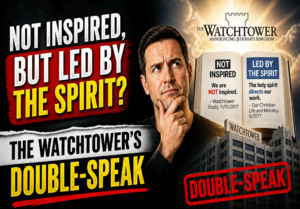
While they confidently assert that they are the faithful and discreet slave selected by Jesus himself to lead all Christians toward a proper and accurate understanding of the Bible, the governing body does acknowledge an important distinction: they are not inspired by God in the same way that the early followers were.
“In the first century, the governing body was not only led by the spirit, but in matters of doctrine, even inspired. Today, it’s not inspired, but still led by the spirit.” – Gerrit Losch: Your Leader Is One the Christ 2019 Annual Meeting
Fast forward to the present day, and although they may not claim to be inspired in the same manner, they firmly believe that they are still being led by the Holy Spirit in their endeavors. They describe themselves as merely imperfect individuals who are earnestly striving to follow the guidance of both the Holy Spirit and Christ in their teachings and practices.
So, what does it really mean to be led by the Spirit? How does being inspired by the Holy Spirit differ from actually being guided by it? And is there a fleeting moment of divine intervention—maybe just a minute—that helps people grasp the meaning of the scriptures?
Anthony Morris (former governing body member) makes it clear that the guidance from their organization doesn’t come from just “mere man”. He insists that their direction and wisdom are rooted in something much higher. – Anthony Morris III: Organized to Do God’s Will
This claim raises a pretty intriguing question.
If the governing body is truly being guided by God’s Holy Spirit, how do we explain the various mistakes that pop up in their doctrinal understanding and organizational direction? Are they suggesting that the Holy Spirit can make errors? When they misinterpret or misapply teachings, does that mean God or Jesus gave them the wrong information in the first place?
Jesus made it clear to his disciples that he would be sending the Holy Spirit to be by their side. He reassured them that this divine presence would guide them in understanding all the truths they needed. He explained, that when the Helper arrived—someone he would send from the Father—it would be the Spirit of truth, coming straight from the Father himself. This Spirit wouldn’t just be there with them; it would also testify about him, reinforcing his teachings and highlighting the importance of his mission.
“But when the Helper comes, whom I shall send to you from the Father, the Spirit of truth who proceeds from the Father, He will testify of Me.” John 15:26
“However, when He, the Spirit of truth, has come, He will guide you into all truth; for He will not speak on His own authority, but whatever He hears He will speak; and He will tell you things to come.” – John 16:13.
You might want to check out how this concept is laid out in “Insight on the Scriptures.”
Under the subheading The Spirit of Truth
“The Spirit of the Truth.”The spirit that proceeds from Jehovah God is pure and holy. It is “the spirit of the truth.” (Joh 14:17; 15:26) Jesus Christ told his disciples: “I have many things yet to say to you, but you are not able to bear them at present. However, when that one arrives, the spirit of the truth, he will guide you into all the truth, for he will not speak of his own impulse, but what things he hears he will speak, and he will declare to you the things coming.”—Joh 16:12, 13.
“God’s spirit would teach them everything they needed to know to carry out their work, recalling and opening up to their understanding things they had previously heard from Jesus but had not understood. (Joh 14:26) God’s spirit would also declare to them “the things coming.” This could include bringing to light the significance of Jesus’ death and resurrection, as these events were then yet future and were among the things that his disciples did not understand. (Mt 16:21-23; Lu 24:6-8, 19-27; Joh 2:19-22; 12:14-16; 20:9) Of course, God’s spirit later also enabled Christ’s followers to foretell future happenings. (Ac 11:28; 20:29, 30; 21:11; 1Ti 4:1-3) Being “the spirit of the truth,” God’s holy spirit could never be the source of error but would protect Christ’s followers from doctrinal falsehoods.” – Insight on the Scriptures, Vol. II, page 1131-1132
Now, if we accept that God’s Holy Spirit is incapable of making mistakes, it raises an interesting question: Was the spirit trying to guide the governing body in a specific direction, but they just couldn’t catch on—even for a fleeting moment? That seems a bit far-fetched for a few reasons. First, let’s consider that quote from the insight book, which clearly states that the Holy Spirit protects Christ’s followers from doctrinal errors. If that’s true, how could the Holy Spirit possibly be involved in the mistakes made by the governing body? This really makes us think about the nature of divine guidance and the role of the Holy Spirit in keeping our beliefs on the right track.
The Watchtower Society dives into yet another fascinating aspect of the Holy Spirit’s work. They believe that some individuals among them are specially anointed to rule alongside Christ in the heavenly realm. This idea really highlights their view of divine selection and purpose.
Take a moment to consider how Steven Lett expresses the certainty of God’s communication with these anointed ones—there’s absolutely no room for doubt in his mind:
“Think about it. The Holy Spirit is the most powerful force in the universe.
Jehovah used it to create the sun, moon, stars. He used it to create all life in
heaven and earth. He also used it to communicate his message to the Bible writers. In fact, Jehovah is the greatest communicator in the universe. So if his powerful Holy Spirit bears witness with a person, he is not going to communicate. Maybe you have been called to heavenly life leaving the person in doubt, a dilemma, a quandry. No, it is going to be an absolute affirmative communication leaving the person with no question in his mind or heart. So if a person is wondering if he is anointed or not, the answer is obvious, isn’t it? He is not.” – Memorial Morning Worship—M. Stephen Lett: “The Spirit Itself Bears Witness With Our Spirit”
Now, think about this for a moment: how could it be that God, the ultimate communicator in the universe, would use the Holy Spirit—the most powerful force we know—to guide a governing body in such a way that they completely miss the point?
So, instead of thinking God made a mistake, maybe we should consider that there’s something off about the governing body’s claim that they’re being divinely guided.
You know, they actually came pretty close to admitting that they offered guidance to God’s people even before the Holy Spirit took the lead. To really drive this home, let’s take a look at an example from the book God’s Kingdom Rules.
5 As we saw in Chapter 2 of this book, the Bible Students spent decades pointing out that the year 1914 would be significant in fulfilling Bible prophecy. However, at that time they believed that Christ’s presence had begun in 1874, that he had begun to rule in heaven in 1878, and that the Kingdom would not be fully set up until October 1914. The harvest would extend from 1874 to 1914 and would culminate in the gathering of the anointed to heaven. Do mistaken ideas such as these cast doubt on whether Jesus was guiding those faithful ones by means of holy spirit?
6 Not at all! Think again of our opening illustration. Would the premature ideas and eager questions of the tourists cast doubt on the reliability of their guide? Hardly! Similarly, although God’s people sometimes try to work out details of Jehovah’s purpose before it is time for the holy spirit to guide them to such truths, it is clear that Jesus is leading them. Thus, faithful ones prove willing to be corrected and humbly adjust their views.—Jas. 4:6.” – God’s Kingdom Rules! pg 50, pp 5,6
Let’s take a moment to really think this through. When the book raises the question of whether mistaken ideas might shake our belief that Jesus is guiding faithful individuals through the Holy Spirit, do you honestly think the answer should be “no”?
If you do believe “no” is the right answer, how do you make sense of the next paragraph? It specifically states that “God’s people sometimes try to work out details of Jehovah’s purpose before it’s the right time for the Holy Spirit to guide them to such truths.” If someone is trying to figure out the specifics of Jehovah’s purpose before the Holy Spirit is ready to lead them, how can they claim to be truly influenced by that Spirit? It feels like there’s a big contradiction here that we can’t just brush aside.
It seems pretty clear that, instead of genuinely following the Holy Spirit, the governing body has been jumping ahead of Jehovah’s timing and direction for over a century.
At the heart of their mistakes lies a certain overconfidence—an assumption that they have everything figured out. It’s not Jesus, God, or even the Holy Spirit who’s to blame for these missteps; it’s really their own presumptuousness.
In an effort to project an image of divine guidance, they work hard to keep their followers loyal, making sure these individuals trust them wholeheartedly. Instead of inviting a closer look at their errors, they’d rather their witnesses focus on what they call “adjustments” or “clarifications” whenever they claim to have hit the mark. It’s all about maintaining that sense of certainty, even when things don’t quite add up.
They have an incredible knack for building genuine excitement among the audience as everyone eagerly awaits the next annual meeting. It’s that time of year when they roll out important updates and share fresh insights that are meant to enlighten everyone in attendance.
However, instead of seeing these updates for what they really are—essentially corrections of past mistakes that hint they might not have had divine guidance all along—many attendees have been conditioned to view these changes as new revelations from God. It’s pretty surprising how rarely it seems to occur to them that today’s adjustments could very well be revised down the line, possibly ending up as just another set of misinterpretations.
“In recent years, the annual meeting has been an occasion where clarified understanding of Bible truths. A new light has been announced and explained. Of course, it’s not at every annual meeting that this takes place, but when Jehovah makes something known, often it’s at the annual meeting where it is announced. Now, will there be new light today? I think Brother Cook already stole the beans a bit. But we look forward to see what will be what is in store for our program. The governing body is neither inspired nor infallible and so it can err in doctrinal matters or in organizational direction. The brothers do the best they can with what they have and what they understand at the time but are happy if Jehovah sees fit to clarify matters and then that can be shared with the brotherhood. And when that happens, we understand it’s because it’s Jehovah’s time for that to happen. And we eagerly accept that.” – Jeffrey Winder: How Does the Light Get Brighter?
Ironically, the official teaching is that Jesus returned in October 1914, and after inspecting all the religions of the world he chose the Watchtower in March 1919. They see this year as a major turning point after enduring years of tough challenges and testing. It was during this time that the Governing Body was officially set free, which led to a complete reorganization of the group. This fresh start allowed them to dive into a new and energized phase of public ministry. For Jehovah’s Witnesses, these changes are seen as the fulfillment of prophetic signs mentioned in Revelation 11, as well as the appointment of what they call the “faithful and discreet servant slave Class”
So while holding onto C.T. Russell’s publishing house, they dismissed everything he ever contributed. Since 1919, they have flip-flopped on every major and minor doctrine. As “New Light”, “Adjustments” and “refinements.” It’s been 107 years, since Jesus supposedly chose and appointed them, and they still don’t have the Truth, because Truth is irrelevant. What’s Truth today, changes tomorrow. One wonders how many adjustments and refinements can they come up with before they run out of theology?
Leave a Reply