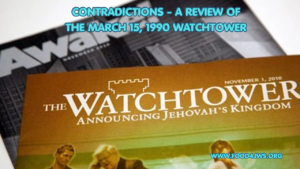
Jehovah’s Witnesses have some misconceptions about the early days of the Watch Tower Society. The leadership have written about the years before 1925 as if there was a governing body back then, but that’s not really the case. They claim there was a governing body in 1918, but the reality is that it didn’t actually come about until many years later.
Truth is, the Governing Body have a habit of twisting things or even making outright false claims about what Charles Taze Russell wrote and taught. The fact is, C.T. Russell never supported the organization that we now know as Jehovah’s Witnesses.
After Russell passed away, “Judge” Rutherford took over through some sneaky moves and started pushing new ideas that led his followers further away from the Bible. One of the biggest shifts he made was regarding the ransom. The teachings from Governing Body and those from the Pastor Russell are so different that we really see them as two separate ideologies.
The Governing Body of Jehovah’s Witnesses claim that the Messiah “came to inspect his slaves in 1918.” You can find this statement in the March 15, 1990 issue of The Watchtower, on page 13, paragraph 18. The article is titled: “The Faithful Slave and Its Governing Body.” However, it’s worth mentioning that the current leadership of Jehovah’s Witnesses has updated this claim, moving the date of the alleged inspection from 1918 to 1919. This adjustment aligns with the same Watchtower publication:
“Well, by then [1918], who had given sincere truth-seekers the correct understanding of the ransom sacrifice….?”
The answer given is:
“The facts show that it was the group of anointed Christians associated with the publishers of the magazine Zion’s Watch Tower and Herald of Christ’s Presence, now called The Watchtower Announcing Jehovah’s Kingdom.”
It should be noted that by 1918, “Zion” had been dropped from the title of the magazine, it was The Watch Tower and Herald of Christ’s Presence.
It’s essential to recognize that in 1918, while Rutherford seemed to be making progress with his innovative ideas on “organization,” it’s crucial to understand that there was no official “Jehovah’s Witness” organization at that time. The statement given might easily mislead one into thinking that today’s Watchtower teachings diverge from the truth. How can we make sense of this? If Zion’s Watch Tower, now known as The Watch Tower, was sharing accurate insights about the ransom-sacrifice back in 1918, it stands to reason that the teachings of the contemporary Watchtower cannot be correct. Let’s delve deeper into this matter.
What’s the current stance of The Watchtower on the ransom-sacrifice concept?
To answer this, we can look at the March 15, 1990, edition of The Watchtower, which sheds light on the subject. On page 5, paragraph 2, we read:
“Jesus came `to give his soul a ransom in exchange for many.’ (Mark 10:45) But who are the many? Adam is evidently excluded because he was a perfect man who deliberately chose to disobey God and died as unrepentant, willful sinner.”
The article goes on to say on paragraph 4:
“The course taken by each individual determines whether he will benefit from Jesus’ sacrifice. Like Adam, the willfully wicked do not have the ransom merit and eternal life forced upon them. As Christ said: `He that exercises faith in the Son has everlasting life; he that disobeys the Son will not see life, but the wrath of God remains upon him.’ (John 3:36)”
The current stance put forth by The Watchtower essentially labels anyone who chooses to disregard the directives of its Governing Body—who assert they speak for Jesus—as deliberately wicked. Consequently, these individuals are seen as having no claim to the ransom that is offered. This viewpoint notably neglects the teachings in John 12:46-48, which clearly state that those who defy Jesus in this life will encounter judgment on resurrection day. For now, the inherited wrath from Adam continues to weigh on these individuals. Moreover, according to the beliefs of the Governing Body, even Adam himself would be viewed as receiving no advantage from the ransom provided.
Now, let’s take a moment to position this modern perspective with the teachings expressed in August 15, 1918, Watch Tower:
“When this ransom price shall have been formally delivered over to Justice in the end of this Gospel age, then, it will … have been exchanged for Adam and his posterity, the world of mankind, all of whom will be immediately transferred by the Father to the Son, that the work of the Millennial Kingdom may begin. The ransom price is designed to bring to Adam and his race the earthly life and the earthly life-rights and honors which were lost in Eden through disobedience.” (See Reprints, page 6314)
Again in The Watch Tower of October 1, 1918 (Reprints, page 6337), we find this statement:
“As in the one man Jesus Christ both Adam and all his children will be justified from the original condemnation, that which came upon the human race because of Adam’s disobedience.”
Take a moment to reflect on those two quotes, drawn from those 1918 editions of The Watch Tower. The way the concept of the ransom is expressed back then stands in stark contrast to its presentation in March 15, 1990 issue. In the 1918 view, it’s made clear that Adam and all his descendants are meant to benefit from the ransom. Yet, in the 1990 interpretation, as articulated by the Governing Body, it claims that Adam will gain nothing from the ransom. Moreover, it’s highlighted that countless individuals alive today might also face destruction when Satan’s world comes to an end, implying they too will miss out on this ransom. Now just recently in 2025, the Governing Body admitted on JW Broadcast, that they didn’t know. That it was possible for the inhabitants of Sodom and Gomorrah to receive a resurrection. Adam however? Stays dead.
Taking a moment to reflect on the points raised earlier should lead us to acknowledge that if The Watch Tower was indeed conveying the truth about the ransom back in 1918, it logically follows that the current teachings of The Watchtower are fundamentally flawed, as they don’t correspond with those earlier messages. It’s crucial to understand that just because the entire world benefits from the ransom offered by Jesus, it doesn’t mean that “everlasting life” will be “imposed” on anyone against their will. Instead, it signifies that everyone will receive a genuine chance to align themselves with Jehovah and His Son, Jesus Christ. Those who ultimately decide to turn away from this opportunity will face the serious consequence of eternal destruction in the second death, which will take place at the end of the 1,000-Year Reign of Jesus, when the Kingdom is handed back to the Father. This concept is backed by numerous scriptures, including Revelation 20:7-9, Psalm 37:9,10, Matthew 25:41,46, and 2 Thessalonians 1:9,10, along with 1 Corinthians 15:24.
In our view, we generally align with the teachings of The Watch Tower from 1918; therefore, we find ourselves at odds with the contemporary teachings of The Watchtower, which claim that Jesus did not give his life as “a ransom for all.” This vital teaching of “ransom for all” is important as it serves to vindicate Jehovah, showing that He is the rightful ruler and that His ways are the best in every aspect of life. It’s solely through this “ransom for all” that all the wicked will ultimately come to know Jehovah. This notion is reiterated in Psalm 83:18, you know that verse, it’s been drilled into your brains:
“That men may know that thou, whose name alone is Jehovah, art the most high over all the earth.” (KJV)
Now compared that with Ezekiel 16:62,63:
“‘And I myself will establish my covenant with you; and you will have to know that I am Jehovah. Then you will remember and be too ashamed to open your mouth because of your humiliation, when I make an atonement for you despite all that you have done,’declares the Sovereign Lord Jehovah.” (NWT)
This further highlights the significance of this teaching in grasping God’s plan for humanity.
We must, with complete sincerity, recognize that The Watchtower, in its current form, strongly holds the belief that countless souls who have passed away without salvation will indeed be resurrected on that glorious day. They’ll have the chance to follow Jesus during the millennial kingdom. For reference, check out the “Questions From Readers” on page 31 of the March 15, 1990 Watchtower. Yet, as we delve into this belief, we stumble upon a striking inconsistency in logic. This inconsistency reveals itself when we look at page 4 of the same March 15, 1990 edition of The Watchtower, where additional details prompt us to question this perspective.
“When Adam sinned, he lost everlasting perfect human life, with all rights and prospects. Hence, the same thing was redeemed by means of Jesus’ ransom sacrifice.”
A bold and unmistakable declaration is made about the essence of redemption, yet right after, the logical outcome stemming from this declaration is dismissed. If we embrace the idea that Adam’s “everlasting perfect human life” was truly redeemed by the ransom, it naturally follows that Adam would be liberated from the death sentence that sin cast upon him. To suggest otherwise would fundamentally weaken the core principle of the ransom itself, which is pivotal to this conversation.
So, there’s a suggestion that Adam did not show remorse for his actions. However, it’s vital to highlight that the Scriptures do not clearly indicate whether he repented. We’re left in the dark regarding his feelings of regret. In fact, there are multiple reasons to entertain the notion that Adam might have genuinely changed his heart after his fall. Still, it’s essential to acknowledge that Jehovah didn’t offer any form of salvation to Adam contingent upon his repentance. Instead, a different and somewhat unclear path to deliverance was hinted at when Jehovah addressed the serpent, proclaiming: “I will put enmity between you and the woman, and between your seed and her seed. He will bruise you in the head, and you will bruise him in the heel.” (Genesis 3:15) This statement hints at a profound plan that goes beyond human comprehension. How much more profound and wise are Jehovah’s ways compared to the often flawed reasoning of humanity!
It’s interesting, one can search for “Adam and the ransom” on JW.ORG and find all kinds of articles and comments that are similar to this March 15, 1990 Watchtower.
If you look at the Watch Tower index, under “Ransom”, there’s a section that reads “not for all” with a slew of references of all those who are not covered by the ransom. And yet, doesn’t 1 Timothy 2:6 state that Jesus: “… gave Himself a ransom for all”?
In the reasoning book on page 397 it states:
“if Jehovah had forgiven Adam’s deliberate sin, it would really have made God a party to the wrongdoing. That would not have improved conditions on earth at all. (Compare Ecclesiastes 8:11.) Furthermore, it would have resulted in disrespect for God on the part of his angelic sons, and it would mean that there was no real basis for hope of anything better. But such a situation could never have occurred, because righteousness is an unalterable foundation of Jehovah’s rulership.—Ps. 89:14.”
I’m sorry, but that’s just utter hogwash. The Society states that Jehovah not only didn’t know Adam would sin, but he chose not to know. Huh? If I’m almighty God, and I create life as free moral agents, I understand that they may very well abuse that right, and with an infinite mind like God’s, the moment I think about that scenario, I have the answer.
Let’s give the Society the benefit of the doubt, even if God didn’t know Adam would sin, He most certainly knew that sin could enter the world and as such, created a way out, without compromising his justice. Luke 14:28 tells us ‘what man before building, doesn’t count the costs’? Since we’re made in God’s image, wouldn’t that scenario apply to our Creator? That before he created the universe, and decided to create humans, he made a checklists of sorts. The Watchtower wants us to believe that God was totally caught off guard by sin, and had to think fast, and then had to manipulate humanity to achieve His desired result. If that was the case, they didn’t have free-will.
Bible Students believe that God knew from the very beginning, even before the beginning of creation, sin was inevitable, and if and when it entered, how would He deal with it? And so Jesus was slain before the foundation of the earth, the Witnesses are taught, that, that foundation started with the fall of humanity. There is no Hebrew word for that definition. God knew, and there was no way out of it, if He was going to give them free-will. He had to allow them to taste sin.
On the bottom of page 119, of The Divine Plan of the Ages (Studies in the Scriptures Volume I) it starts, and please bear with me:
“God could have made mankind devoid of ability to discern between right and wrong, or able only to discern and to do right; but to have made him so would have been to make merely a living machine, and certainly not a mental image of his Creator. Or he might have made man perfect and a free agent, as he did, and have guarded him from Satan’s temptation. In that case, man’s experience being limited to good, he would have been continually liable to suggestions of evil from without, or to ambitions from within, which would have made the everlasting future uncertain, and an outbreak of disobedience and disorder might always have been a possibility; besides which, good would never have been so highly appreciated except by its contrast with evil.”
On the bottom of page 121, Russell asked, and I’ll paraphrase.
Couldn’t there have been another way for man to learn about evil without experiencing it? We know things through intuition, observation, experience, and trusted information. Intuition is a direct understanding unique to our Heavenly Father, the ultimate source of wisdom. Therefore, man’s understanding of good and evil can’t be intuitive. While man can learn through observation, this requires witnessing evil and its consequences, implying that evil must exist somewhere. So, why not among humans on earth?
Adam had knowledge of evil through information, but it didn’t stop him from experimenting. Adam and Eve recognized God as their Creator with the authority to guide them, and He warned them about the forbidden tree: “In the day thou eatest thereof, dying thou shalt die.” Thus, they had a theoretical understanding of evil, despite never having seen or experienced its consequences.
Experience is the only option. I can tell my young daughter, ‘don’t touch the stove, it’s hot, you’ll get burned’. But at 5 years of age, she doesn’t know what “hot” or “burn” really is. I can fence off the kitchen to keep her out, but her curiosity will always be there. I can yell and scream at her, while that may spook her, it’s not going to ease her mind. Sometimes, you just have to let them touch the stove, feel the heat and experience the burn, for them to learn the lesson of disobedience, and that daddy was right.
You know, God knew that when He gave us free will, we’d probably end up choosing sin because we just don’t get how serious the consequences can be. As we got more used to sin, it started to look way more tempting than doing good, which really messes with our moral compass. But here’s the thing: God allowed evil because He also gave us a way to deal with the fallout. This helps us see just how serious sin really is and appreciate the value of being virtuous. Going through this whole experience can actually deepen our love for God, who is the very definition of goodness, and make us really want to steer clear of evil. In the end, this journey leads to a stronger love for God and helps us build a lasting sense of righteousness for those of us who take these lessons to heart.
Leave a Reply