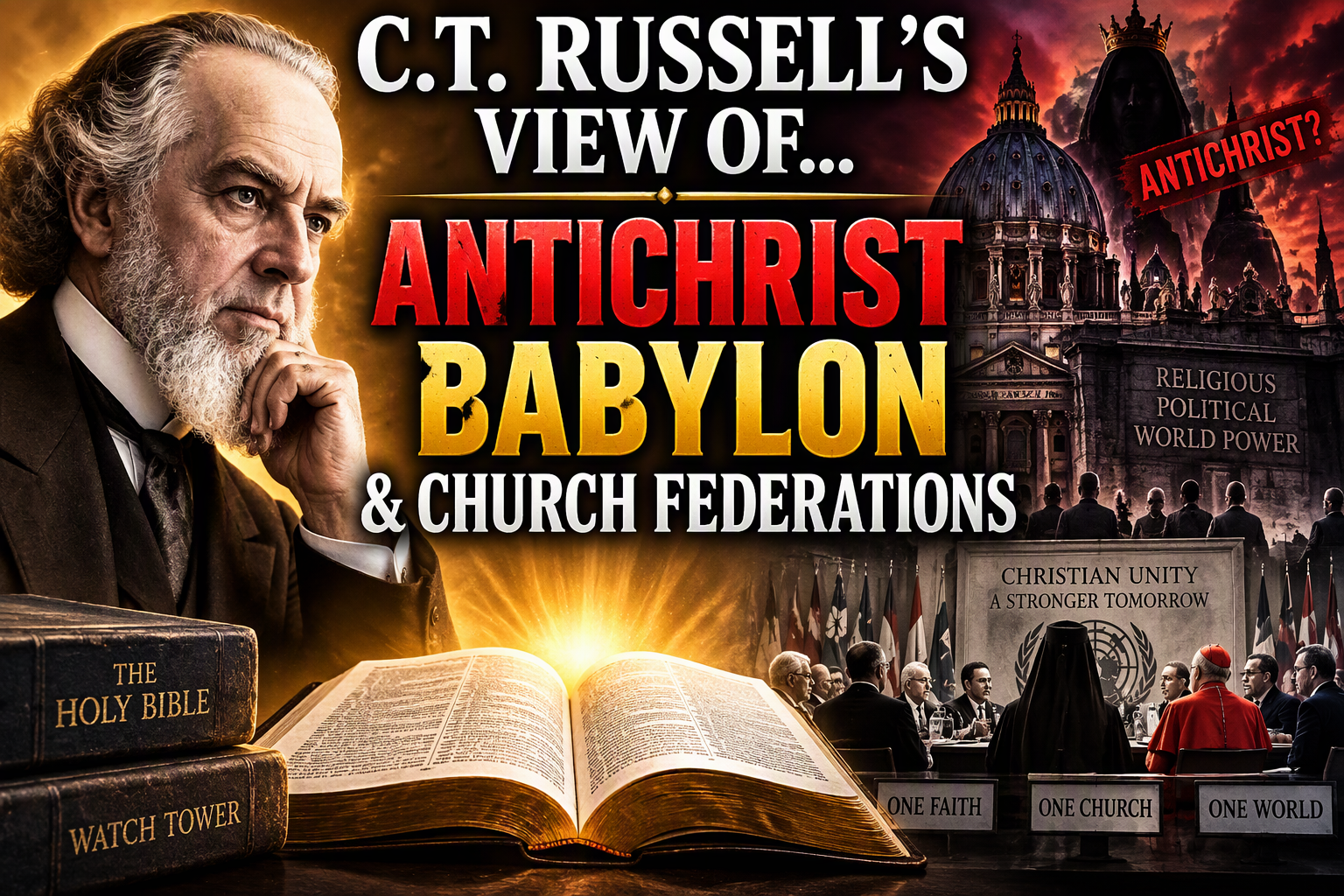
One of the most distinctive aspects of Charles Taze Russell’s prophetic interpretation was his conviction that many of the Bible’s major prophetic symbols referred to the same historical development viewed from different angles. Rather than expecting a single future Antichrist who would arise shortly before the end of the world, Russell believed the prophecies of Daniel, Paul, and Revelation described a long historical process that unfolded within Christendom itself. According to his view, the “Man of Sin,” the “Antichrist,” the “Little Horn,” the “Beast,” and “Babylon the Great” were not separate prophetic entities but interconnected symbols pointing to the rise of ecclesiastical power after the apostolic age.
Russell began with the Apostle Paul’s warning in 2 Thessalonians 2 that a “falling away” would occur before the full establishment of Christ’s Kingdom. He understood this apostasy as a gradual departure from the simplicity of apostolic Christianity. As the church grew in influence and numbers, religious leaders increasingly accumulated authority, eventually creating powerful ecclesiastical institutions. Russell identified this development as the emergence of the “Man of Sin” and the “Antichrist.” Rather than viewing these figures as individual persons, he saw them as a religious system that claimed to represent Christ while gradually assuming powers and prerogatives that belonged to Christ alone.
Within this framework, Russell identified the medieval papal system as the principal historical manifestation of these prophecies. He believed the papacy fulfilled the characteristics assigned to the Man of Sin because it rose within the professed Christian church, exercised spiritual authority over millions, and claimed far-reaching religious powers. The same system, he argued, was represented by Daniel’s Little Horn, which emerged from the divisions of the Roman Empire, spoke great things, and exercised authority over an extended period of history. To Russell, these various prophetic symbols converged upon a single historical reality: the rise of a powerful church-state system centered in Rome.
Yet Russell’s interpretation did not stop with Roman Catholicism. When he turned to Revelation 17, he found a broader picture. There, the symbolic woman is called “Babylon the Great, the Mother of Harlots.” For Russell, the title itself implied that there must be not only a mother but also daughters. The mother represented the original ecclesiastical system that had united religious and political authority, while the daughters represented later religious bodies that inherited some of the same characteristics.
This led Russell to a more nuanced assessment of Protestantism. He viewed the Protestant Reformation as a positive and necessary development. Reformers such as Luther and Calvin helped expose errors and abuses that had become entrenched in medieval Christianity. In Russell’s view, the Reformation restored important truths and challenged the authority of a corrupt religious system. However, he believed that many Protestant denominations eventually repeated some of the very patterns they had originally opposed.
Russell distinguished carefully between individual believers and religious institutions. He did not regard sincere Christians within Protestant churches as part of the Antichrist. Rather, he believed that many genuine followers of Christ could be found throughout Catholic and Protestant denominations alike. His concern centered on religious organizations when they accumulated excessive authority, imposed creedal conformity, or sought influence through political means. To the degree that Protestant denominations adopted structures and practices resembling those of Rome, he viewed them as symbolic daughters of Babylon.
This interpretation became especially important in Russell’s understanding of Revelation 18:4, where God’s people are called to “come out of her.” Russell reasoned that if God addressed “my people” while they were still within Babylon, then sincere Christians must exist inside many different religious organizations. Babylon, therefore, could not be limited to a single church. Instead, it represented the broader system of institutionalized Christendom that had become entangled with human authority and worldly power.
These beliefs also shaped Russell’s view of the growing church union movements of his day. During the late nineteenth and early twentieth centuries, various Protestant denominations began exploring closer cooperation through councils and federations. While Russell favored Christian fellowship and spiritual unity among believers, he was deeply suspicious of organizational consolidation. He feared that federations of churches could gradually reproduce the same sort of centralized religious authority that had developed in medieval Christendom.
This concern led him to identify church federations with another prophetic symbol: the “Image of the Beast” in Revelation 13. In Russell’s interpretation, the Beast represented the original papal church-state system, while the Image of the Beast represented a Protestant counterpart that mirrored some of the same institutional characteristics. The image was not identical to the Beast, but it resembled it. As Protestant churches increasingly united through formal organizational structures, Russell believed they risked recreating the very model from which the Reformation had once separated.
At the heart of Russell’s prophetic framework was a concern not merely about false doctrine but about concentrated religious authority. He believed history demonstrated a recurring pattern: religious institutions begin with noble purposes, accumulate authority over time, and eventually place human leadership between believers and Christ. In his view, prophecy repeatedly warned against this tendency. Whether expressed through the Man of Sin, the Antichrist, the Beast, Babylon, or the Image of the Beast, the underlying lesson remained the same. Whenever religious organizations elevate institutional authority above individual Christian liberty and direct accountability to Christ, they move toward the conditions these prophetic symbols describe.
Consequently, Russell’s interpretation was not ultimately centered on predicting a future villain. It was centered on understanding how ecclesiastical power had developed throughout Christian history and how that power could reappear in new forms. The focus of prophecy, in his view, was less the identity of a single end-time figure and more the continuing danger of religious systems that claim Christ’s authority while gradually obscuring His headship over the church. For Russell, the great prophetic drama was the rise, exposure, and eventual fall of those systems as the truth of God’s Word increasingly revealed their nature and prepared the way for Christ’s Kingdom.
Leave a Reply