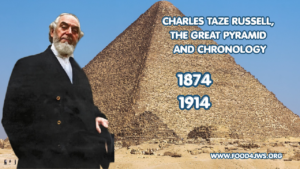
You know, there’s this accusation that keeps popping up, saying that C.T. Russell supposedly figured out 1914 using pyramid measurements. They claim he predicted the “end of the world” for that year, and when it didn’t happen, he supposedly changed the pyramid measurements in later editions of Thy Kingdom Come to cover his tracks. But honestly, that story is misleading on a bunch of levels.
What was Russell’s view of the Great Pyramid? He answers it in Thy Kingdom Come (Studies in the Scriptures Volume III) pages, 314, 315:
“The Great Pyramid, however, proves to be a storehouse of important truth–scientific, historic and prophetic–and its testimony is found to be in perfect accord with the Bible, expressing the prominent features of its truths in beautiful and fitting symbols. It is by no means an addition to the written revelation: that revelation is complete and perfect, and needs no addition. But it is a strong corroborative witness to God’s plan; and few students can carefully examine it, marking the harmony of its testimony with that of the written Word, without feeling impressed that its construction was planned and directed by the same divine wisdom, and that it is the pillar of witness referred to by the prophet in the above quotation.”
Let’s talk about the so-called “growing pyramid.” Critics often look at the 1897 edition of Thy Kingdom Come and compare it to later editions—like 1916, 1918, or even 1923—and they point out that a measurement of 3416 inches was later printed as 3457 inches, claiming the pyramid “grew” by 41 inches over 19 years.
But here’s the thing: this comparison misses a key detail. The change in measurement actually first showed up in the 1905 edition—nine years before 1914. So, this means the change had nothing to do with 1914 “failing,” nor was it an attempt to hide anything. A lot of folks who repeat this accusation probably don’t even know about the 1905 edition; the person who originally made this argument really misrepresented the timeline. The change happened only seven years after the first edition, not 19.
Now, what did the earlier editions actually say? Before 1905, Thy Kingdom Come laid out this reasoning: a measurement of 1542 inches symbolized the year 1542 B.C., and then 3416 inches symbolized 3416 years, leading to A.D. 1874.
Here’s the exact quote:
“This measure is 1542 inches, and indicates the year B.C. 1542, as the date at that point. Then measuring down the “Entrance Passage” from that point, to find the distance to the entrance of the “Pit,” representing the great trouble and destruction with which this age is to close, when evil will be overthrown from power, we find it to be 3457 inches, symbolizing 3457 years from the above date, B.C. 1542. This calculation shows A.D. 1915 as marking the beginning of the period of trouble; for 1542 years B.C. plus 1915 years A.D. equals 3457 years. Thus the Pyramid witnesses that the close of 1914 will be the beginning of the time of trouble such as was not since there was a nation – no, nor ever shall be afterward.”
Russell thought this pointed to the start of the “time of trouble.” It’s important to get that Russell’s prophetic framework wasn’t based on pyramid measurements but on Biblical chronology, as he discussed in earlier studies in his Volumes II and III. The pyramid was just a symbolic confirmation, not the source of the dates.
Back in 1897, nobody had actually measured the floor of the lower part of the descending passageway because it was all filled with debris. So, the measurement wasn’t based on a real measurement of the floor; it was more like an attempt to extend measurements of the ceiling down to the floor.
Why did they update the measurement? After 1904, Russell changed his view on the “time of trouble.” He started to believe that the “time of trouble” would kick off in 1914, not wrap up then. Plus, no one had actually measured the floor of the lower descending passageway because of all that debris.
So, Russell figured out a new measurement based on what was shown in Smythe’s diagram. That’s why the 1905 edition says: 3457 inches corresponds to 3457 years, leading to A.D. 1915, which Russell linked to the start of the trouble. He still maintained that the end of 1914 was a turning point.
Russell never really explained how he got either measurement, but he often referred to October 1914 as the start of the Jewish year 1915, which might have made sense to him for why the measurement ended in 1915 instead of 1914.
Importantly, this adjustment didn’t change when the Gentile Times ended, which Russell always said was October 1914. And it didn’t change the date of 1874 to 1914, as some people claim. Russell believed until he passed away that Christ returned in 1874 and that the end of the age started then. The change we’re talking about—found on page 342 of Thy Kingdom Come—was publicly noted in The Watch Tower back on September 15, 1909, years before 1914.
The 1909 notice explained:
“Page 342, lines 17–18: 3416 inches changed to 3457 inches to agree with later accurate measurement… The former figures were ‘paper measure’ from Piazzi Smyth’s illustration, supposed to have been drawn to scale, but found inaccurate.”
This shows that the adjustment was made openly, long before 1914, and had nothing to do with failed expectations or any cover-up. The dates 1874 and 1914—based on Biblical chronology, not pyramid measurements—stayed the same.
Now, some critics say Russell changed the pyramid measurements because the predicted date proved false. But that argument falls apart when you look closely: the original date linked to the earlier measurement was 1874, not 1914, and 1874 had already come and gone before Thy Kingdom Come was even published. Russell didn’t change anything about 1874, except that he no longer thought the time of trouble had started then; the re-measurement didn’t shift the date from 1874 to 1914.
The change happened in 1905, not after 1914. And Russell never taught that 1914 would be the end of the world. The accusation relies on mixing up dates, editions, and interpretations in a way that clouds the actual historical sequence.
Russell thought the updated figure published in 1905 was more accurate, but neither the earlier nor later number came from a direct physical measurement. At that time, as already stated, the lower part of the descending passageway was blocked by debris, so measuring it on-site was impossible. Both figures were calculated from Piazzi Smyth’s diagram, which Russell thought was drawn to scale.
Morton Edgar later explained the situation in detail. In early editions of Thy Kingdom Come, Studies in the Scriptures, Volume III, Russell listed the length of the descending passage as 3416 inches. Starting in 1905, this was updated to 3457 inches, which shifted the symbolic date associated with the passage from 1874 to 1915.
Edgar pointed out that Russell didn’t give a detailed explanation for the change, although there was a brief discussion in the November 1, 1904 Watch Tower. Back then, Russell just relied on Smyth’s diagram and thought it backed up the 3416-inch figure. He also acknowledged that the lower passageway was filled with debris, so no direct measurement could be taken.
The first actual measurement happened in 1909 when the Edgar brothers cleared and measured the lower descending passageway. Their findings showed that neither of Russell’s earlier figures was correct. The true length was about 3385 Pyramid inches (3384.904), which is 31 inches shorter than Russell’s original 3416-inch figure and 72 inches shorter than the later 3457-inch figure. This was the first time an actual measurement—not just a diagram-based estimate—was taken.
Despite the difference, the Edgars concluded that the corrected measurement actually supported the symbolic dates 1874 and 1914 even more strongly. They shared their findings with Russell right away.
Russell’s 1905 adjustment didn’t change his prophetic dates. He kept teaching that 1874 was the start of Christ’s invisible presence and that 1914 marked the end of the Gentile Times. Other pyramid measurements still pointed to 1874, and Russell held onto this belief until he passed away in 1916.
So, to sum it up: 1914 wasn’t based on pyramid measurements. Russell used Biblical chronology to figure out the date. The Great Pyramid was just seen as a confirming witness, not the source. The measurement change happened in 1905, not after 1914, and Russell never predicted the end of the world for 1914. Claims of a “cover-up” are based on incorrect comparisons of editions and dates.
IN CONCLUSION
You know, there’s a bit of a misconception floating around about Charles Taze Russell, the guy who started the Watchtower organization. Contrary to what some folks say, he didn’t figure out the year 1914—or even 1874—by measuring the Great Pyramid in Egypt. It’s surprising how many websites keep spreading this myth.
The whole idea of 1914 marking the end of the Gentile Times actually comes from a book called Horae Apocalypticae, written by Edward Bishop Eliott, an Anglican minister, back in 1844. That’s eight years before Russell was even born! Eliott based his calculations on biblical timelines and prophecies, and he also referenced some work by a British vicar, named Christopher Bowen from around 1830, who suggested that 6,000 years of human history wrapped up in 1873.

Then in 1859, a former Millerite named Nelson H. Barbour read Eliott’s book and bought into that timeline.

Fast forward to 1864, when British astronomer Piazzi Smyth, who was the Astronomer Royal for Scotland and taught at the University of Edinburgh, published a book called Our Inheritance in the Great Pyramid, (which is still published to till this day.)He had all sorts of measurements of the Great Pyramid of Giza and, following some ideas from Isaac Newton, claimed it held prophecies that could be uncovered through detailed measurements. But he didn’t mention 1874 or 1914 at all.

In 1873, using Bowen’s timeline, Barbour figured that the return of Jesus would kick off in 1874.
Then in October 1876, Russell’s first known article came out in the Bible Examiner, titled “Gentile Times: When Do They End?” In it, he laid out his belief that 1914 marked the end of the Gentile Times—not the end of the world, just to clarify—based on the Bible. No pyramid talk there.

But he was aware of the pyramid theories since he read the Bible Examiner and was friends with its editor, George Storrs. Plus, Piazzi Smyth had published an article on the subject in June.

In 1877, Lutheran theologian Joseph Seiss released a book about the pyramid called Miracle in Stone, and Russell acknowledged that he was influenced by Seiss and others.

In 1889, Russell published the second volume of his Millennial Dawn series, The Time Is At Hand, where he detailed his timeline—including 1874 and 1914—showing it was based on biblical prophecies and parallels. Then in 1891, he published volume III, Thy Kingdom Come, dedicating chapter 10 to the Great Pyramid. He linked its measurements from Piazzi Smyth to his timeline, including those years again. He wrote in his last forewords to this volume in 1916:
“The Great Pyramid of Egypt discussed in this Volume has not lost any of its interest to the author. … We have never attempted to place the Great Pyramid, some times called the Bible in Stone, on a parallel or equality with the Word of God as represented by the Old and New Testament Scriptures—the latter stand pre-eminent always as the authority. We do, however, still believe that the structure of this Pyramid, so different from that of all other pyramids, was designed of the Lord and intended to be a Pyramid and a witness in the midst and on the border of the land of Egypt. (Isaiah 19:19) It certainly tells a very different story from any other art or relic handed down from its remote times.” (1916 Forewword, page ii, iii)

In Chapter 10, he wrote the following:
“The Great Pyramid, however, proves to be a storehouse of important truth-scientific, historic and prophetic-and its testimony is found to be in perfect accord with the Bible, expressing the prominent features of its truths in beautiful and fitting symbols. It is by no means an addition to the written revelation: that revelation is complete and perfect and needs no addition. But it is a strong corroborative witness to God’s plan; and few students can carefully examine it, marking the harmony of its testimony with that of the written Word, without feeling impressed that its construction was planned and directed by the same divine wisdom, and that it is the pillar of witness referred to by the prophet Isaiah at [Isaiah 19: 19, 20]”
So, to sum it up, Russell’s timeline wasn’t based on the pyramid’s measurements. He always said that the Great Pyramid just backed up his findings about biblical chronology.
Leave a Reply