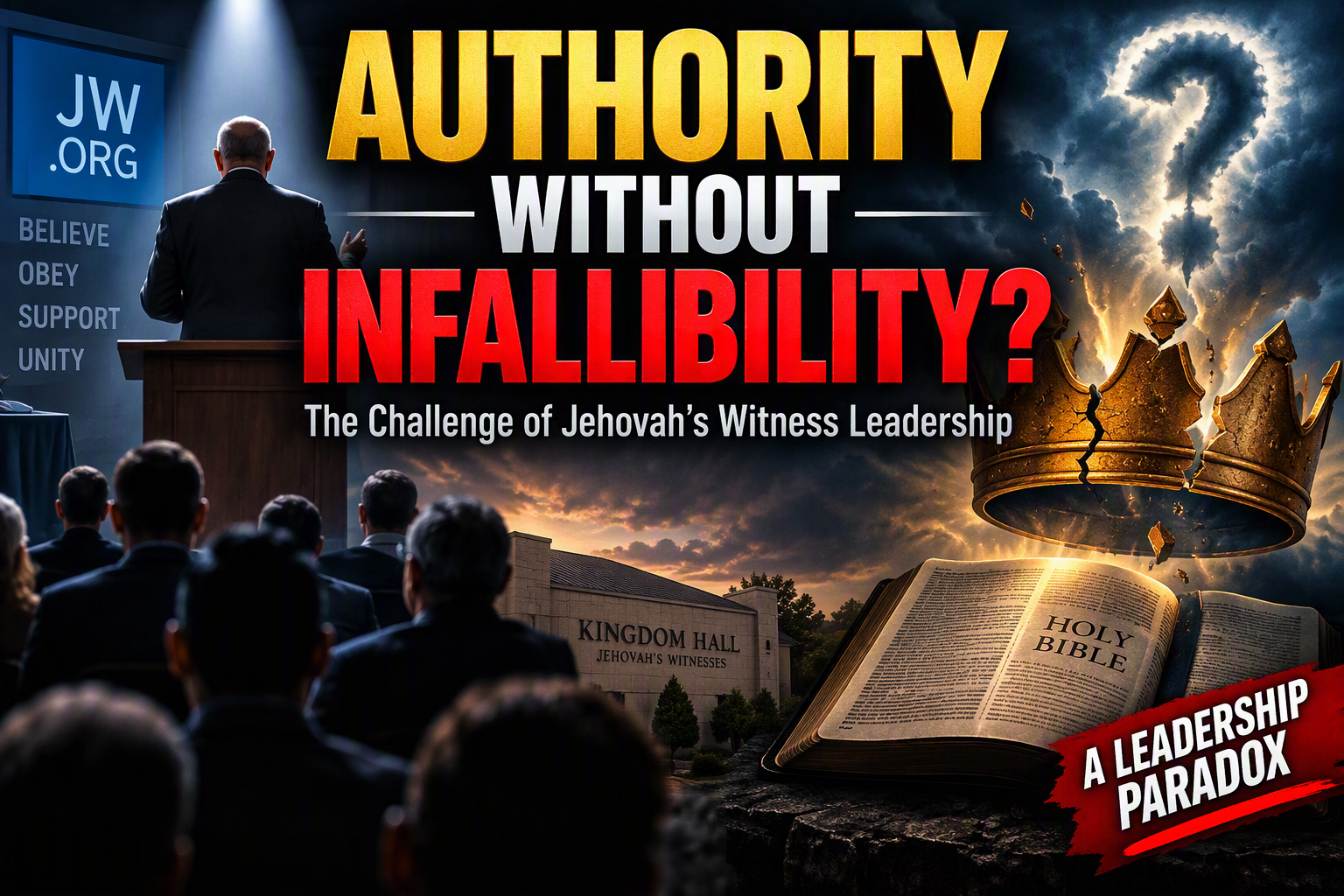
One key question raised by the beliefs of Jehovah’s Witnesses is about the authority of their leaders, especially since they admit they are not perfect. This topic gained attention when Geoffrey Jackson, a member of the Governing Body, spoke at the Australian Royal Commission in 2015. He mentioned that it might be “quite presumptuous” to say that the Governing Body is the only group God speaks through. For many former Jehovah’s Witnesses, this statement clashes with the strong authority the Governing Body holds in the organization. This discussion goes beyond just one person’s words; it raises a bigger issue: If the Governing Body isn’t inspired or infallible, why do they expect such high obedience from their members?
The Governing Body’s Admission of Fallibility
Jehovah’s Witnesses don’t teach that the Governing Body is inspired in the same sense as the biblical prophets and apostles. In fact, the organization has explicitly acknowledged its limitations in recent years.
In the February 2017 issue of The Watchtower, readers were told:
“The Governing Body is neither inspired nor infallible. Therefore, it can err in doctrinal matters or in organizational direction.”
“They are not inspired by God and hence are not infallible.”
These statements are important because they acknowledge that the Governing Body, which is responsible for guiding the beliefs and practices of its followers, can make errors. This includes mistakes not just in how they manage things but also in how they understand and explain their religious teachings. Many Christians would likely agree with this idea since most major Christian groups accept that people in leadership positions can sometimes be wrong. The real question that arises from this acknowledgment is what actions or changes should be considered after recognizing that even religious leaders can make mistakes. This could lead to discussions about how to address these errors and what it means for the faith and its followers.
The Governing Body’s Claim to Divine Appointment
Jehovah’s Witnesses believe that while the Governing Body is not perfect and can make mistakes, it still holds a special position in God’s plan. This group of leaders is seen as having a unique responsibility to guide and direct the beliefs and practices of the entire organization. They provide teachings and interpretations of the Bible that members are encouraged to follow, which shows how important their role is in helping people understand their faith. Even though they acknowledge that the Governing Body can err, its members are still viewed as essential for maintaining unity and direction within the community of Jehovah’s Witnesses.
The July 2013 issue of The Watchtower explains:
“That faithful slave is the channel through which Jesus is feeding his true followers in this time of the end.”
The article continues:
“It is vital that we recognize the faithful slave. Our spiritual health and our relationship with God depend on this channel.”
Similarly, the official website of Jehovah’s Witnesses states:
“Today, from his position in heaven, Jesus directs his followers on earth by means of a ‘faithful and discreet slave.’”
According to current Witness teaching, that “faithful and discreet slave” is the Governing Body.
Consequently, the organization simultaneously teaches two propositions:
- The Governing Body can make mistakes.
- The Governing Body is the channel through which Christ directs his people.
The relationship between these two statements has sparked a lot of discussion and disagreement among Current and former Witnesses. Many have different opinions about how these claims relate to each other, leading to various interpretations and arguments. Some believe that one claim supports the other, while others think they contradict each other completely. This ongoing debate highlights how complex this topic is, as some try to understand the implications of each claim and what they mean in a broader context.
The Dilemma of Authority
For those who have left the Jehovah’s Witnesses, the core issue isn’t just about the mistakes that have occurred; it’s more about how much power and authority is given to teachings that can later be altered. Over the years, the Jehovah’s Witnesses have seen several of their key beliefs shift and evolve. The literature produced by the organization itself often refers to these changes as “Beliefs Clarified,” suggesting that they are simply refining their understanding of the Scriptures. They frame these adjustments as signs of growing spiritual insight rather than failures on their part. However, critics raise an important concern: if a belief can be discarded later as “old light,” how can a member accurately assess its validity while it is still being promoted? This becomes even more complicated when questioning these teachings can lead to disciplinary actions, yet those same teachings might eventually be revised. This situation leads many former members to feel that a contradiction exists. The organization’s leaders admit that they can make doctrinal errors, yet they still expect members to treat those teachings as absolute truth until they are officially changed by the same leaders who established them. To many critics, this creates a practical sense of infallibility; although the organization claims that its leaders are not infallible in theory, in practice, any dissent from current teachings is often discouraged, leaving members in a confusing and challenging position.
How Faithful Witnesses View the Matter
Jehovah’s Witnesses would firmly reject the criticisms mentioned earlier, believing that throughout history, God’s servants have always been flawed individuals. For instance, they highlight that Moses, despite his significant role, made errors, and King David, a revered figure, committed serious wrongdoings. Even the apostle Peter, who was one of Jesus’ closest followers, needed to be corrected at times. Nevertheless, Jehovah’s Witnesses emphasize that God continued to use these imperfect individuals for His purposes, suggesting that divine appointment does not hinge on being flawless. Furthermore, they argue that having a central authority is crucial for maintaining unity among believers. Without a guiding body, they fear that interpretations of the Bible could become disorganized and inconsistent. They reference the early Christian congregation, where apostles and elders played vital roles in settling doctrinal disagreements and coordinating missionary efforts. The Governing Body of Jehovah’s Witnesses sees itself as following this historical example, believing that it is fulfilling a similar function today. Therefore, they generally conclude that the Governing Body should be trusted, not because its members are free from mistakes, but because they believe Christ has chosen them to lead and provide guidance for the global congregation.
Why Geoffrey Jackson’s Testimony Was So Significant
Geoffrey Jackson’s testimony during the Australian Royal Commission turned out to be very important for many people who used to be Jehovah’s Witnesses. When he mentioned that it would be “quite presumptuous” to say that the Governing Body is the only group that God speaks through, it caught the attention of many. This statement felt quite different from what they had read in the organization’s publications, which often stressed that the Governing Body is the main channel through which Christ communicates and that recognizing this is crucial for one’s spiritual health. Because of this, former Jehovah’s Witnesses frequently refer to his testimony as a turning point that encouraged them to think more deeply about issues like authority, accountability, and personal conscience. For these individuals, the matter goes beyond just what was said in court; it raises important questions about whether the power held by the Governing Body is justified, especially considering the organization’s own acknowledgment that it can make mistakes in its teachings or decisions.
Conclusion
The main issue at hand isn’t about whether the Governing Body of Jehovah’s Witnesses is flawless, as even the members themselves admit that it has its shortcomings. Instead, the crucial question revolves around the extent of authority that should be granted to leaders who openly acknowledge that they are not inspired or infallible. Jehovah’s Witnesses believe that their leaders are divinely appointed and that maintaining unity within the organization justifies following them, even with their human imperfections. On the other hand, those who have left the faith argue that leaders who are capable of making mistakes should only have persuasive authority, meaning they should encourage followers to think critically rather than enforce strict adherence to doctrines. This debate really gets to the core of what religious authority means. If a group of leaders can make mistakes, should their teachings be accepted simply because of their position, or should they only be accepted if they can consistently prove their validity through Scripture? How individuals respond to this question will significantly influence whether they view the authority structure of Jehovah’s Witnesses as sensible, troubling, or something in between.
Leave a Reply