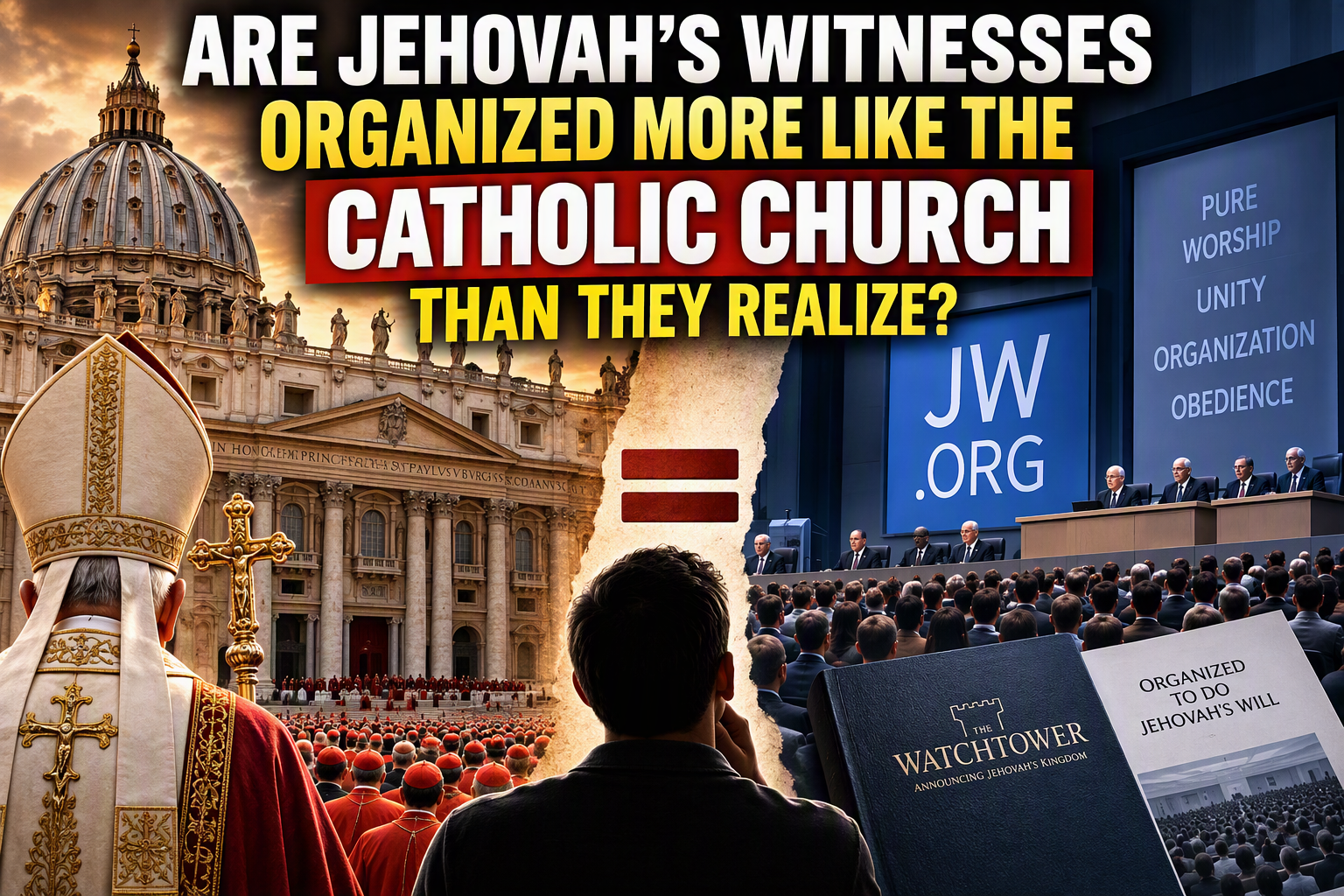
Jehovah’s Witnesses have always set themselves apart from the Catholic Church, often depicting Catholicism as part of “Babylon the Great.” They reject the pope’s authority, deny apostolic succession, and criticize various Catholic beliefs. Because of this, many Jehovah’s Witnesses see their faith as very different from Catholicism in terms of both beliefs and structure.
However, if you take a closer look at how authority works in both groups, you’ll find some surprising similarities. Even though their teachings are quite different, both organizations depend on a central leadership, have a hierarchical structure, maintain uniform beliefs, and expect their members to obey. In some ways, Jehovah’s Witnesses might actually be more similar to Catholics in their organization than they realize.
A Central Governing Authority
Both the Catholic Church and Jehovah’s Witnesses are guided by a small group of leaders who hold significant power over millions of followers worldwide. The Pope, along with bishops and cardinals, leads the Catholic Church, forming a global structure that manages church teachings and governance. The Pope is the main authority figure, making final decisions on church matters. On the other hand, Jehovah’s Witnesses are led by the Governing Body, a small team based in Warwick, New York, which controls doctrine, publications, and organizational policies. This group also oversees branch offices and sets rules for congregations around the world. In both cases, a limited number of leaders wield considerable influence, shaping the beliefs and practices of countless believers.
A Hierarchical Chain of Command
Both Jehovah’s Witnesses and the Catholic Church have a clear hierarchy in their organization. In the case of Jehovah’s Witnesses, the Governing Body is at the top, followed by branch committees, circuit overseers, local elders, and then the individual members of the congregation. The Catholic Church has a similar structure, with the Pope at the top, followed by bishops, priests, and local parishes. In both religions, local leaders are responsible for carrying out the policies set by those above them, and they do not create their own teachings; instead, they follow the doctrines handed down from the central authority. Historically, Protestantism stood out because it rejected this kind of centralized control, promoting local independence and personal study of the Bible. In contrast, both the Catholic Church and Jehovah’s Witnesses focus on a strong central authority to maintain unity and direction within their organizations.
Doctrinal Unity Through Centralized Control
Both the Catholic Church and Jehovah’s Witnesses share a key similarity in their goal of having a consistent belief system around the world. For instance, a Catholic going to Mass in different cities like Indianapolis, Rome, or Manila experiences the same core beliefs and rituals. Similarly, a Jehovah’s Witness attending meetings in places like New York, Brazil, or South Africa learns the same teachings and follows the same guidelines. This kind of uniformity doesn’t just happen on its own; it needs strong leadership to make it work. Both groups ensure that the main interpretations of their beliefs come from their leaders, even though members can read the Scriptures on their own. This approach creates a shared religious identity that goes beyond different countries and cultures.
Authority Beyond Simple Administration
The comparison of leadership in Catholicism and Jehovah’s Witnesses becomes more intriguing when we look at its psychological and spiritual aspects. Catholics typically accept the Pope and bishops as their teaching leaders, believing that Christ set up a visible church and passed down authority through apostolic succession.
On the other hand, Jehovah’s Witnesses do not accept this idea of apostolic succession or papal authority. Instead, they believe that the Governing Body acts as God’s channel for spiritual guidance, claiming to follow the example of the apostles and elders from the early church.
As a result, members of both groups often turn to a central authority not just for organizational help but also for a clear interpretation of the Bible. While the reasons behind their beliefs differ, the way they rely on these authorities can look quite similar.
The Question of Obedience
One of the most debated similarities between Catholics and Jehovah’s Witnesses is the idea of obedience. Throughout history, Catholics have been taught to respect and follow the authority of the church, even if they don’t completely understand every choice made by their leaders. Similarly, Jehovah’s Witnesses stress the importance of following the guidance of their organization, often referencing scriptures like Hebrews 13:17 to support their cooperation with those in charge. In both groups, being united is seen as a valuable spiritual quality, and any disagreement, especially if made public, can be seen as a threat to the harmony of the community. However, this doesn’t mean that members give up their ability to make choices; they are still accountable for their own actions. Both groups do encourage their followers to have a lot of faith in the decisions made by their leaders.
Important Differences
Even though there are some similarities, there are also significant differences between the Catholic Church and Jehovah’s Witnesses. The Catholic Church has a special priesthood, a deep theological background, and a belief in apostolic succession that goes back almost two thousand years. In contrast, Jehovah’s Witnesses completely reject these ideas. They do not have priests, do not perform sacraments like the Catholic Church, and believe that only Christ is the leader of their congregation. The Governing Body makes it clear that they do not take the place of Christ’s leadership.
These differences are quite important and shouldn’t be overlooked. However, acknowledging these distinctions doesn’t mean we should ignore the similarities in their structures.
A Thought-Provoking Irony
Jehovah’s Witnesses often see themselves as different from the Catholic Church, criticizing its leadership and traditions. However, their own structure has become quite centralized and hierarchical, similar to what they oppose. While the two groups have different beliefs, it’s interesting to consider how they both manage their followers. Both have a central leadership, stress the importance of unity, ensure consistent teachings worldwide, and expect members to follow guidance from their leaders. From a sociological viewpoint, the real difference might not be about having authority but rather who is seen as having that authority.
Conclusion
Jehovah’s Witnesses and Catholics have very different beliefs, but they share some key similarities in how they are organized. Both groups operate on a global scale and have a structured hierarchy. They place a lot of power in a small group of leaders and aim for unity in their teachings through centralized control. Additionally, both encourage their members to have faith in their leaders. This comparison doesn’t determine which group is correct; instead, it shows that even religious movements with strong disagreements can be quite similar in their organization and governance. This aspect can be particularly interesting for those studying religion.
Leave a Reply