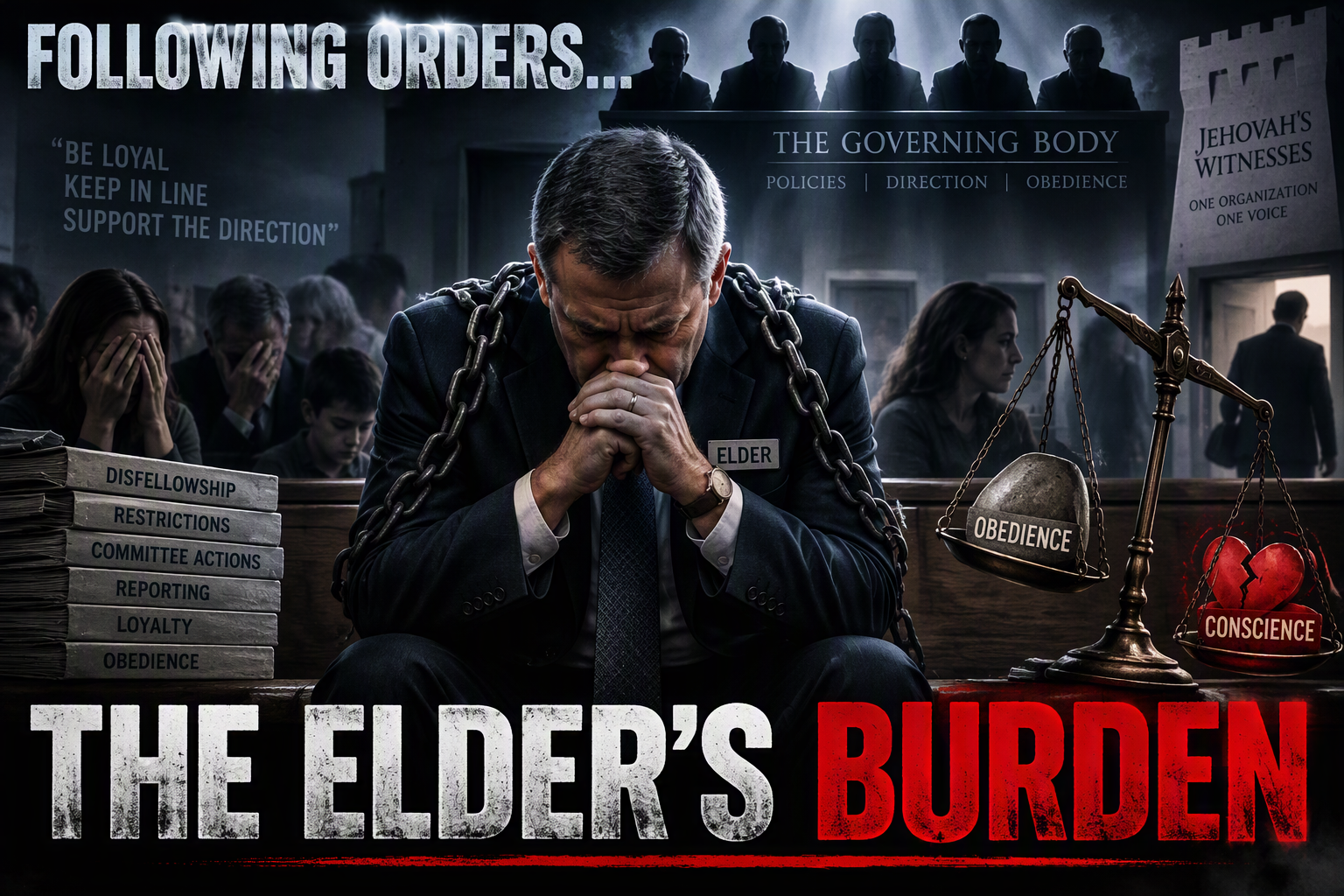
Among former Jehovah’s Witness elders, there are many who look back on their years of service with mixed emotions. Some remember the friendships they formed, the people they tried to help, and the sincere faith that motivated them. Yet alongside those memories, many also carry a profound sense of guilt. For them, the explanation, “We were just following commands,” does not fully resolve the questions that linger in their minds or the weight that remains on their consciences.
This burden is often misunderstood. Outsiders may assume that elders knowingly harmed others, while current members may assume that elders who feel regret are simply bitter or disloyal. The reality is usually much more complex. Most elders did not serve because they wanted power or because they intended to hurt others. On the contrary, many devoted countless hours to what they sincerely believed was God’s work. They visited the sick, comforted grieving families, organized congregation activities, and sacrificed personal time in an effort to help others spiritually. They believed they were acting out of love for God and concern for their fellow believers.
For that reason, the guilt some former elders experience is not rooted in malicious intent. It is rooted in the painful gap between what they intended to accomplish and what they later came to understand.
At the time, many believed that strict enforcement of organizational policies was an expression of love. They believed disfellowshipping protected the congregation. They believed reporting wrongdoing upheld God’s standards. They believed obedience to organizational direction demonstrated loyalty to Jehovah. Within that framework, difficult decisions often appeared both reasonable and necessary.
However, as the years passed, some began to see another side of those decisions.
They remembered young people who were struggling and needed understanding but instead faced disciplinary action. They remembered families divided by shunning. They remembered individuals suffering from depression, anxiety, or personal crises who were viewed primarily through the lens of organizational rules. They remembered people whose honest questions were interpreted as rebellion and whose doubts were treated as spiritual weakness.
What once seemed like faithful obedience began, in some cases, to look like the application of policies that produced unintended but very real harm. The elders involved had often believed they were acting lovingly and responsibly. They trusted that organizational policies reflected God’s wisdom and that applying those policies faithfully would ultimately benefit those affected. Yet with the passage of time, some came to focus less on the intentions behind those decisions and more on their consequences.
They remembered young people who were labeled spiritually weak when they were actually struggling with anxiety, depression, or questions of identity. They remembered families torn apart by shunning. They remembered sincere individuals whose doubts were treated as rebellion rather than opportunities for honest conversation. They remembered situations in which strict adherence to policy seemed to leave little room for individual circumstances, mercy, or compassion.
This realization was often deeply unsettling. The issue was not that they had intended to hurt people. Many had sincerely believed they were helping. The issue was that good intentions did not always produce good outcomes. Looking back, some began to recognize that policies designed to preserve unity and obedience sometimes imposed significant emotional, psychological, and relational costs on the very people they were meant to help.
It was at this point that a troubling question emerged: If a policy is believed to come from God, but its application repeatedly leaves behind broken relationships, deep emotional wounds, and lingering trauma, how should those outcomes be understood? For some former elders, it became increasingly difficult to dismiss these consequences as isolated exceptions. The human cost could no longer be viewed as an abstraction. It had faces, names, stories, and memories attached to it.
This is often where guilt begins to take root. Not because these men deliberately harmed others, but because they gradually realized that sincere obedience does not eliminate responsibility for the effects of one’s actions. The more clearly they saw the suffering that had resulted, the harder it became to comfort themselves with the thought, “I was only following directions.”
This realization can be deeply painful because many former elders genuinely cared about the people involved. Looking back, they may ask themselves difficult questions:
- Could I have shown more compassion?
- Should I have listened more carefully?
- Did I mistake organizational loyalty for spiritual maturity?
- Were there moments when mercy would have been better than discipline?
These questions can haunt a person precisely because they arise from a sincere desire to have done what was right.
Another source of guilt is the recognition that authority does not remove personal responsibility. Throughout history, human beings have wrestled with the tension between obedience and conscience. Soldiers, government officials, judges, religious leaders, and ordinary citizens have all faced moments when they believed they were doing the right thing because they were following trusted authorities. Later, many came to question whether obedience alone was enough.
Religious history is particularly instructive. Across centuries, religious institutions of many kinds have exercised discipline, enforced doctrinal conformity, and imposed penalties in the name of preserving truth and unity. Those carrying out such actions were often sincere believers convinced they were serving God faithfully. Yet later generations frequently looked back and recognized that sincere motives did not always prevent unnecessary suffering. Again and again, history has demonstrated that conviction and correctness are not always the same thing.
One of history’s recurring lessons is that institutions naturally emphasize order, unity, and compliance, while conscience focuses on individual human beings. Institutions ask whether rules have been followed. Conscience asks whether people have been treated justly. Institutions seek consistency. Conscience seeks compassion. Healthy societies and healthy faith communities need both, but when the demands of an institution completely overwhelm the voice of conscience, painful consequences often follow.
Former Jehovah’s Witness elders may find themselves confronting this tension in a particularly personal way. Many spent years believing that loyalty to organizational direction was synonymous with loyalty to God. To question policies could feel like questioning Jehovah himself. Under such circumstances, obedience did not merely seem reasonable; it was viewed as a sacred duty.
This is why hindsight can be so difficult.
Over the decades, various teachings and policies within the organization have been adjusted, refined, or abandoned. As changes occurred, some former elders found themselves reflecting on decisions they once defended with certainty. Questions naturally emerged. If a teaching once presented as essential was later revised, what should they think about the sacrifices people made because of it? If a policy once enforced strictly was later softened or modified, what about the individuals who suffered under the earlier approach?
These questions are not merely theological. They are deeply personal.
Former elders were not spectators observing organizational history from a distance. They were participants in it. They sat on judicial committees. They delivered difficult announcements. They counseled members according to current organizational understanding. They encouraged compliance with teachings they sincerely believed came from God through his appointed channel.
When those teachings changed or when the human consequences of those policies became more visible, some elders found themselves carrying a burden familiar throughout history: the realization that a person can be sincere, devoted, and wrong at the same time.
For some, the burden grows even heavier when they remember moments of private doubt.
Many would admit that there were occasions when they felt uncomfortable with a decision, questioned a policy, or sensed that a particular situation called for more mercy than the rules appeared to allow. Yet because obedience was strongly emphasized, they pushed those doubts aside. They trusted the organization. They trusted that those above them knew better.
Years later, some have come to realize that the voice they silenced was their own conscience.
This realization can create a unique form of grief. It is not only grief for those who may have been hurt. It is grief for the person they themselves might have been had they listened more carefully to their own moral instincts. They wonder how many opportunities they missed to show greater understanding, patience, or compassion.
Yet compassion must extend not only to those affected by harmful policies but also to the elders themselves.
Many operated within a highly structured belief system that framed obedience as faithfulness to God. Questioning authority could carry tremendous emotional, social, and spiritual consequences. Like countless people throughout history, they were shaped by the environment in which they lived. Understanding these pressures does not erase responsibility, but it does provide important context. Human beings are social creatures. Most find it difficult to stand apart from a community they love, a system they trust, and an authority they believe has divine approval.
That reality should inspire humility rather than judgment.
The encouraging truth is that guilt does not have to be the end of the story.
In fact, the very presence of guilt may reveal something admirable. People whose consciences have become indifferent rarely agonize over past actions. People who no longer care about truth rarely examine themselves honestly. The fact that many former elders wrestle with these questions demonstrates that they still care deeply about justice, truth, compassion, and the well-being of others.
Growth often begins where self-justification ends.
Many former elders have found healing by acknowledging mistakes, listening to those who were hurt, offering apologies where possible, and learning from experiences they once struggled to understand. Some have dedicated themselves to helping others recover from religious trauma. Others have rebuilt damaged relationships. Still others have developed a deeper appreciation for conscience, humility, and compassion than they possessed before.
These acts cannot change the past, but they can transform its meaning.
History offers encouragement here as well. The people most admired today are not necessarily those who never made mistakes. Rather, they are often those who possessed the courage to confront uncomfortable truths, learn from them, and become better human beings as a result. Moral greatness is found not in never being wrong, but in what one does after discovering that one has been.
In the end, the story of former Jehovah’s Witness elders is not simply a story about authority, policy, or organizational loyalty. It is a story about conscience. It is the story of ordinary people who sincerely sought to serve God, only to discover that sincerity alone does not prevent mistakes and that obedience does not eliminate personal responsibility.
The guilt many carry today is painful, but it is also revealing. It reveals that their hearts were never truly hardened. A person who no longer cares about right and wrong feels no remorse. A person whose conscience is dead asks no difficult questions. The fact that these men wrestle with the past demonstrates that they still care deeply about truth, justice, and the well-being of others.
History’s greatest moral failures were not committed solely by wicked people. They were often committed by sincere people who trusted authority more than conscience, loyalty more than compassion, and certainty more than humility. Yet history also shows that some of the most admirable individuals are those who possess the courage to look honestly at their own mistakes and learn from them.
That is why guilt need not be the final chapter. The final chapter can be something far greater.
It can be the chapter in which regret becomes wisdom. It can be the chapter in which former elders listen to those they once judged and discover a deeper compassion than they ever knew before. It can be the chapter in which they find the courage to acknowledge painful truths, seek reconciliation where possible, and extend grace both to others and to themselves.
No one can change the decisions of yesterday. The disfellowshipping announcements cannot be unsaid. The judicial hearings cannot be undone. The opportunities for mercy that were missed cannot be relived. But what can be changed is the meaning of those experiences. Pain can become understanding. Failure can become growth. Regret can become a source of empathy that blesses others for years to come.
Ultimately, a person’s legacy is not determined only by what they once believed or what they once did. It is determined by what they do when they discover they were wrong. The willingness to face uncomfortable truths, to accept responsibility without being crushed by it, and to become a more compassionate human being is one of the highest forms of moral courage.
The burden many former elders carry is real. But if they allow that burden to deepen their humanity rather than destroy it, then their greatest contribution may lie not in the years they spent enforcing authority, but in the years that follow, when conscience finally finds its voice. And when that voice is heard, the story is no longer one of guilt alone. It becomes a story of redemption, healing, wisdom, and hope.
Perhaps that is the deepest lesson of all: no one is forever defined by the system they once served. Human beings are capable of growth. They are capable of repentance. They are capable of change. The measure of a life is not whether one has never erred, but whether one has the courage to follow truth wherever it leads. For those former elders who honestly confront their past, bear responsibility with humility, and choose compassion over self-defense, the future remains unwritten. Their finest moments may not be behind them at all. They may lie ahead, in the difficult but noble work of transforming regret into understanding, understanding into wisdom, and wisdom into love.
Leave a Reply