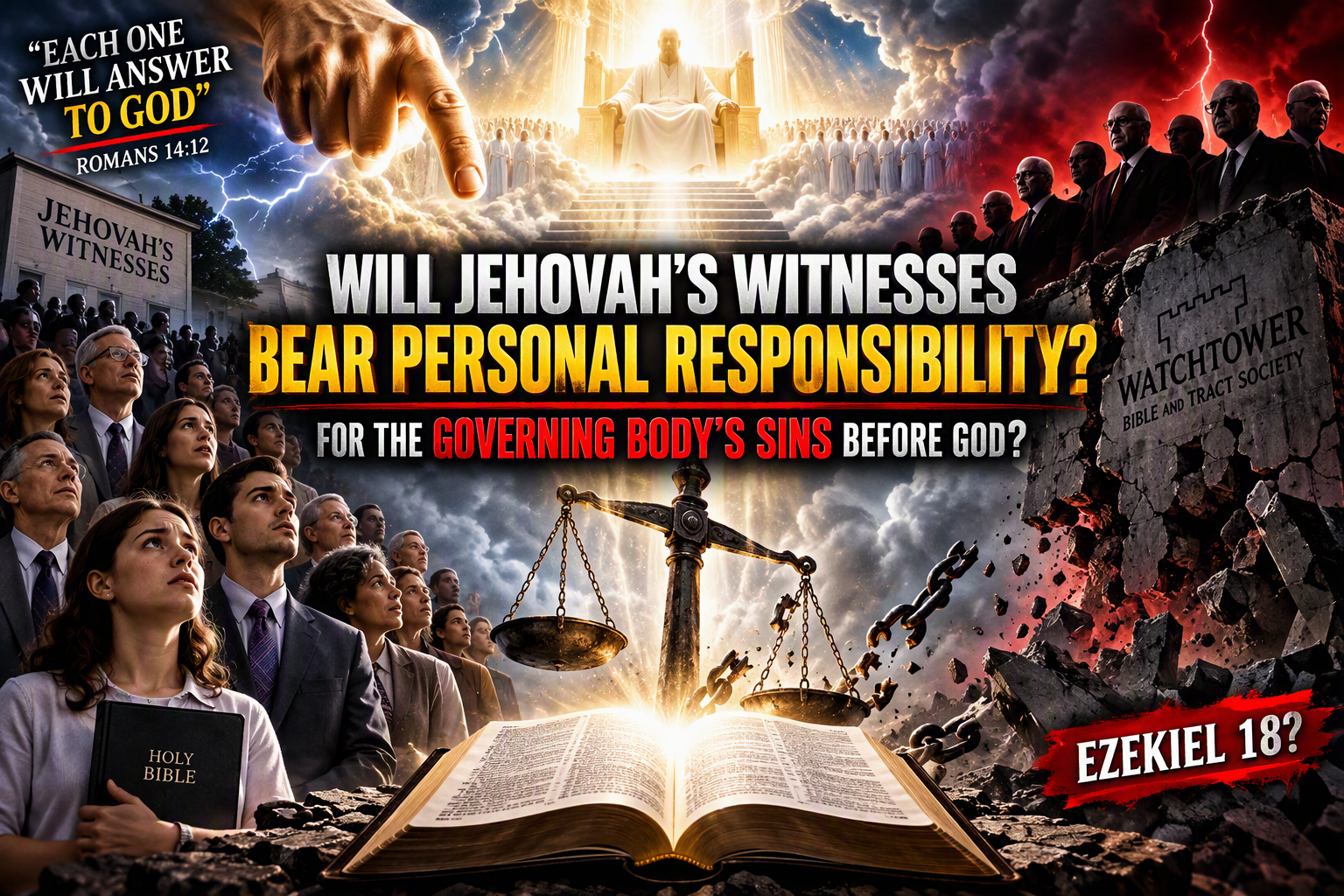
Will Jehovah’s Witnesses bear personal responsibility before God for the sins committed by their governing body?
The answer to that question really depends on your beliefs, it’s ultimately a theological and moral question, as Jehovah’s Witnesses and other Christians have different views on how God assigns responsibility.
From a biblical angle, there are two key views that many Christians see as conflicting:
Individual Responsibility:
Ezekiel 18 tells us that we are all accountable for our own actions. It explains God’s justice, personal responsibility, repentance, and the importance of individual righteousness. This chapter addresses a false proverb in Israel that blamed previous generations for present suffering. God makes it clear that every person is accountable for his or her own choices and actions. Ezekiel 18 reminds believers that God is just, merciful, and willing to forgive anyone who turns from sin and walks in righteousness. So, in the eyes of a Jehovah’s Witness, they wouldn’t be seen as guilty just because the Governing Body made a mistake.
Responsibility for Participating in Wrongdoing:
Some scriptures say that if you support or take part in actions you think are wrong, you can share in that responsibility. This shifts the focus from “What did the Governing Body do?” to “What did the individual know, and how did they act?”
Because of these points, different Christians might respond in various ways:
A devote Jehovah’s Witness might argue that faithful members aren’t to blame for the errors of the Governing Body. They would typically argue:
- Jehovah expects Christians to respect and obey those taking the lead.
- The Governing Body is imperfect and can make mistakes.
- Individual Witnesses are not responsible for honest errors made by leaders if they are sincerely trying to serve God.
What does the Bible say?:
- Hebrews 13:17 tells us to “Be obedient to those who are taking the lead among you and be submissive, for they are keeping watch over you as those who will render an account.” This calls for respect and cooperation with those who take the lead, but not unquestioning blind obedience.
- The Bible repeatedly emphasizes personal accountability before God Romans 14:12 – “So then each of us shall give account of himself to God.”
- Believers are expected to test teachings against Scripture
- Acts 17:11 tells us that Boreans “received the word with all readiness, and searched the Scriptures daily to find out whether these things were so.”
- Jesus commended the the Ephesians in Revelation 2:2 because they “tested those who say they are apostles and are not, and found them to be liars.
- In 1 John 4:1, the Apostle stated “do not believe every spirit, but test the spirits, whether they are of God; because many false prophets have gone out into the world.”
If a person knowingly supports or perpetuates something proven to be wrong, responsibility may extend beyond the leaders themselves.
For example:
- If someone has never encountered contrary evidence and sincerely believes a teaching is biblical, many Christians would view that person differently from a leader who knowingly teaches error.
- If someone becomes convinced that a teaching or policy is wrong yet continues to support or enforce it because of organizational loyalty, many would argue that personal responsibility increases.
The critical issue is often not whether a member is deceived, but what happens when evidence becomes available. God judges each person based on their understanding, motives, and actions, not just because they’re part of a certain group.
Members could bear some responsibility if they knowingly support harmful policies or ignore their conscience.
My mother-in-law was a prime example. She knew that there were things taught by the governing body that she did not agree with, but went along with. Why? Because in her mind Jehovah’s appointed these men as his representatives, His instruments. And as she tells it, “God appointed them to teach, and if they teach me wrong, God will punish them, not me, I’m just following Jehovah’s direction, to obey those who take the lead.”
So the question is not simply:
“Did the Governing Body err?”
but also:
“What responsibility does each individual have to examine, question, and follow conscience and Scripture when they believe a teaching may be wrong?”
From that viewpoint, I would argue that responsibility exists on a spectrum. Leaders generally bear greater responsibility for teaching error, but followers are not necessarily absolved of all responsibility merely because a leader instructed them to do something. The Bible presents both leadership accountability and individual accountability as real principles.
In other words, the issue is not usually framed as “Will all Jehovah’s Witnesses answer for the Governing Body’s sins?” but rather “To what extent is each person accountable for his or her own decisions, beliefs, and actions in relation to those teachings?”
Leave a Reply