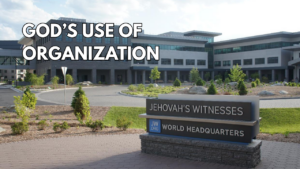
So, in the July 15, 1984 issue of The Watchtower, there are a couple of study articles that dive into how important organization is for worshiping Jehovah God the right way. The first article is titled “Organized to Serve Jehovah,” and it kicks things off by asking:
“Does God deal with people solely on an individual basis? What does-the Bible indicate?” — page 10.
They recognize that “Jehovah really cares about people as individuals” and share a few scriptures that back that up. Then they ask this question:
“But does this mean that individuals here and there throughout many religious organizations of the world are acceptable to God? Or should it be expected that such persons would be associating with one another, would be organized to serve Jehovah?”—page 10.
So, from here on out, they try to make the case that you can only have your worship recognized by God if you’re part of just one organized group. It’s pretty fascinating to see how they bring in the idea of “organization” into the Bible when, honestly, it’s not really there in the Sacred Writings. It kind of shows this “hidden Manna” style of studying the Bible, where you’re just looking for what you already believe before you even dive into the text. Just take a look at how they weave the idea of organization into the story of the Flood:
“But what about the human realm? Well, the Deluge of Noah’s day brought an end to all antediluvian organizations that might have existed on earth—except one. Noah and the seven other Flood survivors emerged from the ark as a family organization. A matter of prime importance to them was the rendering of united worship to God, for we read: ‘Noah began to build an altar to Jehovah and to take some of all the clean beasts and of all the clean flying creatures and to offer burnt offerings upon the altar.’ The Flood survivors did not immediately go their separate ways religiously, but they were all together for this significant event that culminated in blessing, instruction and a covenant originating with God. (Genesis 8:18-9:17) Yes, after the Deluge, Noah’s family started off as an organization that served Jehovah.”—page 11, par. 6.
The Scriptures describe Noah in Genesis 6:9 as a “good man, a man of integrity among his contemporaries, and he walked with God.” But when it comes to his family’s religious beliefs, the Bible doesn’t really say much. What was really important to them? That’s anyone’s guess. They made it through the Flood as a family, but we don’t know how much they shared their father’s devotion to God. Calling them a “family organization” feels a bit off, right? I mean, sure, a family can be “organized” enough to have breakfast together, but that doesn’t really make them an “organization.” When was the last time you heard a family refer to themselves that way? The Bible doesn’t suggest that Noah and his family worshiped God together in any structured way. In fact, not long after the Flood, Noah ended up cursing one of his sons in Genesis 9:20-27. And later, when some of Noah’s descendants tried to band together to form a city-state to avoid being “scattered all over the earth,” God wasn’t happy about it and in Genesis 11:1-9, we read how He messed with their language so they couldn’t pull it off.
The next part of the Watchtower article talks about the nation of Israel:
“The descendants of Abraham were richly favored by Jehovah, and nobody can reasonably deny that they eventually became a national organization. Why, the Bible book of Exodus alone shows how they were delivered from Egyptian bondage and were organized as a theocracy! The book identifies Jehovah as the God of theocratic organization. When the Israelites obeyed God’s Law, they were able to worship him as an orderly, secure and joyful organization. They were undeniably organized to serve Jehovah.”—page 11, par. 7.
You know, the writer of that paragraph really worked the word “organization” in there five times! It just goes to show how obsessed the Society is with the whole “organization” idea and how they tend to go overboard with it. Sure, the priestly Tabernacle service and later the Temple service needed a lot of organization and scheduling to manage all those sacrifices and rituals. But honestly, that “organizing” was just a way to achieve something, not the goal itself.
So, let’s talk about this paragraph that talks about the “Evidence of fine organization … in connection with service at Jehovah’s earthly sanctuary.” It pulls in a few scriptures where the Revised Standard Version uses the word “organized” when referring to this service. You know, like in 1 Chronicles 23:2-6, 24:1-6, and 2 Chronicles 23:18. What’s kind of funny is that they skip over their own New World Translation when quoting these verses since it says “distributed” instead of “organized.” Normally, they’d say the New World Translation is the better choice, but since the RSV uses “organized,” they go with that here.
So, there’s this section in the Watchtower titled “Jehovah—A God of Organization” on page 11. Now, if the Watchtower Society is right that organization is a key part of worshiping Jehovah, it’s pretty odd that the Bible doesn’t really mention it at all. I mean, the word “organization” doesn’t show up in the New World Translation, and you won’t find it in the usual Bible dictionaries either. Even their own dictionary, Aid to Bible Understanding, skips over it. And just to note, the 1988 edition of Insight on the Scriptures does the same thing. Why’s that? Because the Bible doesn’t really treat organization as a big theological idea or depict God as “A God of Organization.” Plus, using Israel’s “national organization” as an example to argue for the benefits of “organization” isn’t exactly convincing. Most of their religious history is a pretty sad tale about the descendants of Abraham. The kings and priests, who were supposed to lead, kept dragging the nation into apostasy over and over. Those few people who were inspired by Jehovah to call out the corruption and warn about the upcoming judgments were seen as rebels and disloyal. For that, they faced hatred, persecution, and slander for speaking against Jehovah’s “national organization.” The chants of “the temple of Jehovah, the temple of Jehovah” didn’t magically protect them from the fallout of their mistakes. Jehovah didn’t just overlook their apostasy because they carried His name. In fact, they ended up being worse than the pagan nations around them. (Check out Jeremiah, Chapter 7.)
When it comes to the Christian community, the Watchtower claims that the early believers were “well organized” under a “governing body made up of the apostles and older men in Jerusalem.” While it’s true that there was some sense of community and teamwork among early Christians who acknowledged the apostles and other teachers, it’s not accurate to say that the congregations were run by a governing body. If you check out the Acts of the Apostles, you’ll see that the holy spirit worked independently of any earthly organization, not through one. The conference in Jerusalem that discussed what was binding on Gentile believers wasn’t called by any so-called “governing body.” Instead, it was the congregation in Antioch that decided to send Paul, Barnabas, and others to Jerusalem. Some brothers from Judea were causing trouble for the Gentile believers, insisting they had to be circumcised and follow the Law of Moses. The Antioch delegation didn’t go to Jerusalem to find out the truth; they went to share the evidence that the holy spirit had already shown them. The conclusion that James shared wasn’t the result of any voting or secret meeting of a “governing body.” It was a conclusion that James and others in Jerusalem had to accept because of the undeniable influence of God’s spirit! (Acts 15).
So, about why being organized is super important these days, the article says:
“There must be agreement among all true Christians, a unified message, if people are to hear what is correct, put genuine faith in the true God and call upon Jehovah’s name with the prospect of being saved.”—pages 14,15 par. 19.
“Today, Jehovah’s Witnesses alone are declaring the good news that the Kingdom has been functioning in the heavens since 1914 with Jesus Christ as King.” —page 15, par. 20.
You know, the “good news” that Jehovah’s Witnesses talk about, as taught by the Watchtower Society, is really different from what the early disciples of the Lord shared. Just take a look at Acts 8:12, 35 and Romans 10:6-10. It’s definitely a whole different kind of Good news, as pointed out in Galatians 1:6-8. This version of the gospel actually comes from 19th-century Adventist ideas and has been tweaked over time because history has shown that their hopes for a new world haven’t panned out. Honestly, there’s not much value in being super organized to spread a message that doesn’t hold up against scripture.
A big part of why the Watchtower organization has been so successful in rallying the unwavering loyalty of Jehovah’s Witnesses comes down to what they call “crisis theology.” This basically means they create a sense of expectation and anxiety among the Witnesses, making them feel like the end is just around the corner. For decades now, phrases like “in the short time remaining” or “very shortly now” have been thrown around to emphasize how close the end is. This approach is still a major theme in Watchtower literature. Young people have been led to think they won’t have to worry about getting old in this system, while older folks are holding on to the hope that they’ll make it through to a cleansed earth because the Society has convinced them that the end is near.
The success the Watchtower Society has had in spreading its message really hinges on the religious fervor sparked by this “crisis theology.” Everyday life and normal pursuits often take a backseat because there’s this urgent feeling that they need to get the message out to save lives. A few quick quotes can really show how much mental reinforcement the Witnesses are constantly facing:
“The great climax is at hand.”—Light, book two, page 327 (1930).
“Armageddon is near, and the conclusion of God’s ‘strange work’ is nearer. “—Face The Facts, page 58 (1938).
“All the facts show that the woes beginning in 1914 have continued to increase upon the earth, and at the present time the distress and woes are greater than ever before known, and this indicates that Armageddon is very near.”— Children, page 151 (1941).
“That Armageddon is at the door the fulfillment of Bible prophecy clearly indicates.”— Awake!, May 22, 1956, page 7.
This issue of the Watchtower we’re discussing is just like the others. The study article titled “Build Your Future With Jehovah’s Organization” encourages readers to get more involved under the guidance of the Watchtower Society. They say:
“We are now deep into ‘the last days’ of this wicked system of things. . . How soon will that occur? Surely before long, for this is the 70th year of Kingdom rule!
Remember, this was written in 1984, it’s now 2026, so it’s 112th year of Kingdom rule!
. . . Its time has nearly run out. . . . With the storm clouds of the ‘great tribulation’ already forming on the horizon, this is no time to plan for a prosperous future in some worldly business firm or to be climbing the corporate ladder.” (excerpts from several paragraphs on pages 16 and 17.)
Those “the storm clouds of the ‘great tribulation’ already forming on the horizon”? Are now in their 42nd year.
The issue with “crisis theology” is that it can lead to some pretty misguided reasons for living out our Christian faith. It’s always been important for folks to hear the amazing news of salvation from God through Jesus Christ. The drive to share that good news really needs to come from inside us, not from outside pressures. That’s where “crisis theology” falls short; it tends to be more about fear than genuine love. When we truly love God and Christ, and we strive to live our lives the way they want us to, there’s no reason to be afraid of our Lord’s sudden return. Each of us has to figure out how to balance our commitment to God with our responsibilities to others. Throughout the ages, the Lord has reminded believers:
“33 Watch! Be alert! For you don’t know when the time is coming. 34 It is like a man on a journey, who left his house, gave authority to his slaves, gave each one his work, and commanded the doorkeeper to be alert. 35 Therefore be alert, since you don’t know when the master of the house is coming—whether in the evening or at midnight or at the crowing of the rooster or early in the morning. 36 Otherwise, he might come suddenly and find you sleeping. 37 And what I say to you, I say to everyone: Be alert!”” Mark 13:33—37 Holman Christian Standard Bible.
Leave a Reply