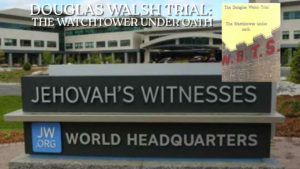
THE WATCHTOWER UNDER OATH
So, the Douglas Walsh trial, which took place in Scotland between November 1954 and January 1955, was a pretty big deal. It was all about whether Jehovah’s Witnesses could be seen as a “religious body” in the UK.
The official name of the case was L. Strachan v. Douglas Walsh, and it went down in the Court of Session in Edinburgh, with the decision coming out in January 1955. Walsh, who was a Jehovah’s Witness, didn’t want to take a civilian job and argued that he should be exempt as a minister. The government pushed back, questioning whether Jehovah’s Witnesses should even be recognized as a religious group. The court looked into how the Watch Tower Society was set up, what it meant to be a minister, and what the Witnesses actually did.
There were some important testimonies from top leaders of the Watch Tower Society, like Fred W. Franz, Grant Suiter and Hayden C. Covington. In the end, the court ruled against Walsh, saying that Jehovah’s Witnesses didn’t fit the legal definition for exemption. But this case actually helped pave the way for later legal recognition of Jehovah’s Witnesses in Britain, leading to more clarity about their status.
What makes this trial stand out is:
- The extensive sworn testimonies from top officials.
- How often it gets cited in discussions about Witness beliefs and authority.
- Its impact on how the government viewed their ministerial structure.
Their insights on doctrine, the role of the Governing Body, and how the organization was run sparked a lot of debate.
It’s also known for the detailed testimonies and its impact on conversations about the organization’s beliefs and authority. If you’re curious, the full transcript is available in the public archives. I’ll post a link to it below in the description section, but be warned it ended up being a whopping 762-page transcript that people still talk about today.
Okay, so, here are the juicy parts of this trial:
The Watchtower Society was trying to show that some of its members were actually ordained ministers. Covington was speaking with the attorney from the Ministry of Labour and National Service. Answering questions in the same manner that Geoffrey Jackson, was being drilled during the Australian Commission.
Q. Is it not vital to speak the truth on religious matters?
A. It certainly is.
Q. Is there in your view room in a religion for a change of interpretation of Holy Writ from time to time?
A. There is every reason for a change in interpretation as we view it, of the Bible. Our view becomes more clear as we see the prophesy fulfilled by time.
Q. You have promulgated — forgive the word — false prophesy?
A. We have — I do not think we have promulgated false prophesy, there have been statements that were erroneous, that is the way I put it, and mistaken.
Q. Is it a most vital consideration in the present situation of the world to know if the prophesy can be interpreted into terms of fact, when Christ’s Second Coming was?
A. That is true, and we have always striven to see that we have the truth before we utter it. We go on the very best information we have but we cannot wait until we get perfect, because if we wait until we get perfect we would never be able to speak.
Q. Let us follow that up just a little. It was promulgated as a matter which must be believed by all members of Jehovah’s Witnesses that the Lord’s Second Coming took place in 1874?
A. I am not familiar with that. You are speaking on a matter that I know nothing of.
Let me interrupt for a moment, there were no Jehovah’s Witnesses in 1874, in fact, there was no Watch Tower Society in 1874. In fact there was no “Jehovah’s visible Organization in 1874.The official teaching of the Society, is thatJesus selected the Watch Tower Society in 1919as his “faithful and discreet slave” or chosen channel.In 2013, however, it was reinterpretated that the “faithful and discreet slave” is NOT the Society, per say, but the members of the Governing Body.
The Governing Body of Jehovah’s Witnesses got its start back in 1971, separate from the corporate officers of the Watch Tower Society. In September of that year, the Society made it clear that the president, who was Nathan Knorr at the time, wouldn’t have all the authority anymore. Instead, they created the Governing Body, made up of anointed men, to handle doctrinal and organizational decisions. This was a big change in how things were run. Some people point to 1919 as the “founding” year because they believe that’s when Jesus appointed the “faithful and discreet slave,” but there wasn’t a formal Governing Body back then; it’s more of a theological date than an actual institutional one.
Q. You heard Mr. Franz’s evidence?
A. I heard Mr. Franz testify, but I am not familiar with what he said on that, I mean the subject matter of what he was talking about, so I cannot answer any more than you can, having heard what he said.
Q. Leave me out of it?
A. That is the source of my information, what I have heard in court.
Q. You have studied the literature of your movement?
A. Yes, but not all of it. I have not studied the seven volumes of “Studies in the Scriptures,” and I have not studied this matter that you are mentioning now of 1874. I am not at all familiar with that.
Q. Assume from me that it was promulgated as authoritative by the Society that Christ’s Second Coming was in 1874?
A. Taking that assumption as a fact, it is a hypothetical statement.
Q. That was the publication of false prophesy?
A. That was the publication of a false prophesy, it was a false statement or an erroneous statement in fulfillment of a prophesy that was false or erroneous.
Q. And that had to be believed by the whole of Jehovah’s Witnesses?
A. Yes, because you must understand we must have unity, we cannot have disunity with a lot of people going every way, an army is supposed to march in step.
Q. You do not believe in the worldly armies, do you?
A. We believe in the Christian Army of God.
Q. Do you believe in the worldly armies?
A. We have nothing to say about that, we do not preach against them, we merely say that the worldly armies, like the nations of the world today, are a part of Satan’s Organization, and we do not take part in them, but we do not say the nations cannot have their armies, we do not preach against warfare, we are merely claiming our exemption from it, that is all.
Q. Back to the point now. A false prophesy was promulgated?
A. I agree that.
Q. It had to be accepted by Jehovah’s Witnesses?
A. That is correct.
Q. If a member of Jehovah’s Witnesses took the view himself that that prophesy was wrong and said so he would be disfellowshipped?
A. Yes, if he said so and kept persisting in creating trouble, because if the whole organization believes one thing, even though it be erroneous and somebody else starts on his own trying to put his ideas across then there is disunity and trouble, there cannot be harmony, there cannot be marching. When a change comes it should come from the proper source, the head of the organization, the governing body, not from the bottom upwards, because everybody would have ideas, and the organization would disintegrate and go in a thousand different directions. Our purpose is to have unity.
Q. Unity at all costs?
A. Unity at all costs, because we believe and are sure that Jehovah God is using our organization, the governing body of our organization to direct it, even though mistakes are made from time to time.
Q. And unity based upon an enforced acceptance of false prophecy?
A. That is conceded to be true.
Q. And the person who expressed his view, as you say, that it was wrong, and was disfellowshipped, would be in breach of the Covenant, if he was baptized?
A. That is correct.
Q. And as you said yesterday expressly, would be worthy of death?
A. I think — — —
Q. Would you say yes or no?
A. I will answer yes, unhesitatingly.
Q. Do you call that religion?
A. It certainly is.
Q. Do you call it Christianity?
A. I certainly do.
Fred Franz, then vice-president of the Society, also answered questions for the attorney for the Ministry of Labour and National Service.
Q. In addition to these regular publications do you prepare and issue a number of theological pamphlets and books from time to time?
A. Yes.
Q. Can you tell me this; are these theological publications and the semi-monthly periodicals used for discussion of statements of doctrine?
A. Yes.
Q. Are these statements of doctrine held to be authoritative within the Society?
A. Yes.
Q. Is their acceptance a matter of choice, or is it obligatory on all those who wish to be and remain members of the Society?
A. It is obligatory………
The British government counselor pointed out some teachings that the Society had turned down, especially those that mentioned specific dates. He wondered how the organization would see someone who admitted the mistake and chose not to accept those teachings. The testimony goes on to explain:
Q. Did [Pastor Russell] not fix 1874 as some other crucial date?
A. 1874 used to be understood as the date of Jesus’ Second Coming spiritually.
Q. Do you say, used to be understood?
A. That is right.
Q. That was issued as a fact which was to be accepted by all who were Jehovah’s Witnesses?
A. Yes.
Q. That is no longer now accepted, is it?
A. No.
……..
Q. But it was a calculation which is no longer accepted by the Board of Directors of the Society?
A. That is correct.
Q. So that am I correct, I am just anxious to canvas the position; it became the bounden duty of the Witnesses to accept this miscalculation?
A. Yes
………
Q. So that what is published as the truth today by the Society may have to be admitted to be wrong in a few years?
A. We have to wait and see.
Q. And in the meantime the body of Jehovah’s Witnesses have been following error?
A. They have been following misconstructions on the Scriptures.
Q. Error?
A. Well, error.
So, they were chatting about the authority of the Society’s publications again. The vice president mentioned that “you don’t have to accept it,” but then he kind of went back to what he said before.
A. These [Watchtower Society] books give an exposition on the whole Scriptures.
Q. But an authoritative exposition?
A. They submit the Bible or the statements that are therein made, and the individual examines the statement and then the Scripture to see that the statement is Scripturally supported.
Q. He what?
A. He examines the Scripture to see whether the statement is supported by the Scripture. As the Apostle says: “Prove all things; hold fast that which is good”.
Q. I understood the position to be — do please correct me if I am wrong — that a member of the Jehovah’s Witnesses must accept as a true Scripture and interpretation what is given in the books I referred you to?
A. But he does not compulsorily do so, he is given his Christian right of examining the Scriptures to confirm that this is Scripturally sustained.
Q. And if he finds that the Scripture is not sustained by the books, or vice versa, what does he do?
A. The Scripture is there in support of the statement, that is why it is put there.
Q. What does a man do if he finds a disharmony between the Scripture and those books?
A. You will have to produce me a man who does find that, then I can answer, or he will answer.
Notice Franz’s waffling. He is unwilling, even under oath, to admit that what we think we know might actually be wrong, even though he’s said before that today’s truths could turn out to be mistakes down the line.
Q. Did you imply that the individual member has the right of reading the books and the Bible and forming his own view as to the proper interpretation of Holy Writ?
A. He comes — — —
Q. Would you say yes or no, and then qualify?
A. No. Do you want me to qualify now?
Q. Yes, if you wish?
A. The Scripture is there given in support of the statement, and therefore the individual when he looks up the Scripture and thereby verifies the statement, then he comes to the Scriptural view of the matter, Scriptural understanding as it is written in Acts, the seventeenth chapter and the eleventh verse, that the Bereans were more noble than those of Thessalonica in that they received the Word with all readiness, and they searched the Scripture to see whether those things were so, and we instruct to follow that noble course of the Bereans in searching the Scripture to see whether these things were so.
Q. A Witness has no alternative, has he, to accept as authoritative and to be obeyed instructions issued in the “Watchtower” or the “Informant” or “Awake”?
A. He must accept those.
So, Haydon C. Covington pointed out that the Watchtower Society seems to care more about keeping everyone united than sticking to what’s actually true doctrinally. This could mean that people might feel pressured to go along with things that aren’t right. Fred Franz backed this up by saying that while the Society talks about looking into the scriptures, they really don’t let members act on what they find if it goes against what the Society teaches. Basically, if you want to stay in good standing, you have to go along with what the Society believes, even if you don’t agree with it personally. This kind of expectation really clashes with the idea that God values honesty. And even though they say they’re not perfect, members can face serious consequences, like being disfellowshipped, just for admitting that the leaders might not always be right. Covington mentioned that this kind of honesty is just not tolerated.
Free Download – Walsh Court Trabscript:
Leave a Reply